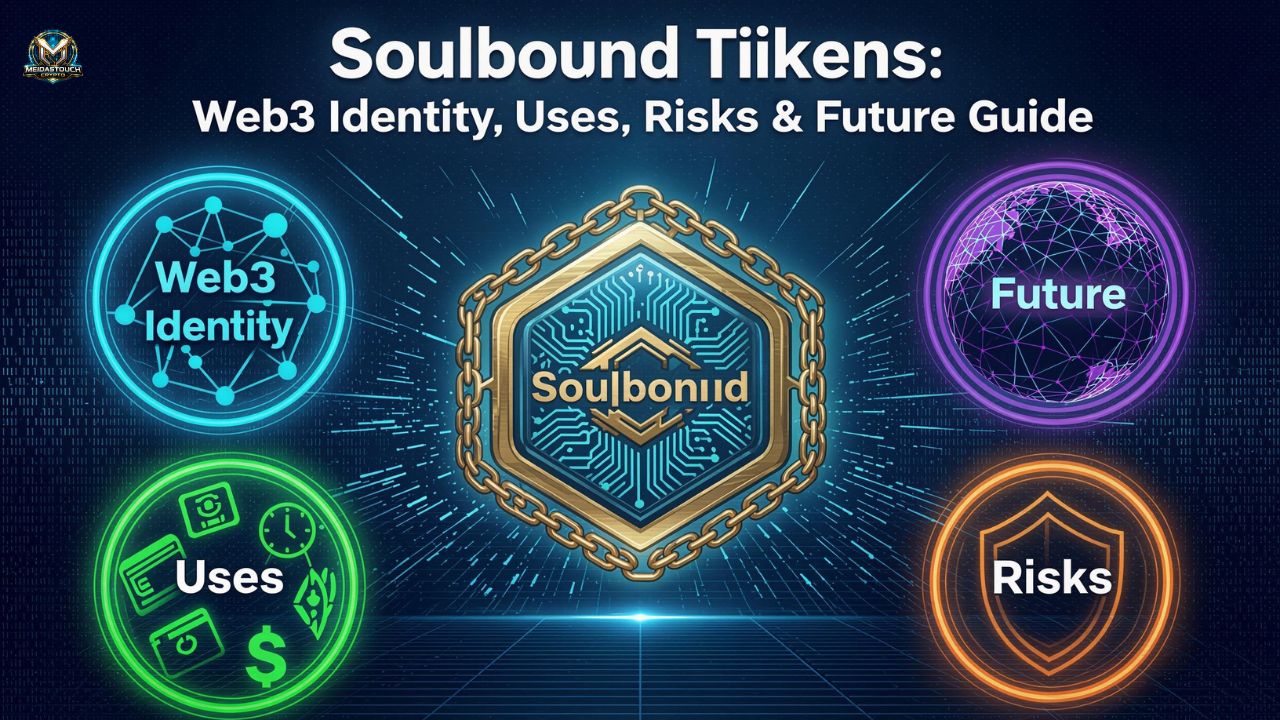
Introduction
Some blockchain ideas sound technical at first, then suddenly feel very personal. soulbound tokens are one of those ideas because they are not mainly about trading, flipping, or chasing the next speculative asset. They are about identity, trust, reputation, and the digital proof of who someone is, what they have earned, and where they belong.
Imagine a university degree that cannot be sold, a professional certificate that cannot be faked, a DAO membership badge that cannot be passed to a stranger, or a proof-of-attendance record that stays connected to the person who actually showed up. That is the promise behind this concept.
The idea became widely known after Vitalik Buterin, Puja Ohlhaver, and E. Glen Weyl published Decentralized Society: Finding Web3’s Soul, a paper describing non-transferable tokens that represent commitments, credentials, and affiliations of “Souls,” or blockchain accounts connected to people, groups, or institutions.
Unlike ordinary crypto tokens, these are not designed to move freely from wallet to wallet. That single difference changes everything. It shifts the conversation from ownership to reputation, from speculation to verification, and from “what can I sell?” to “what can I prove?”
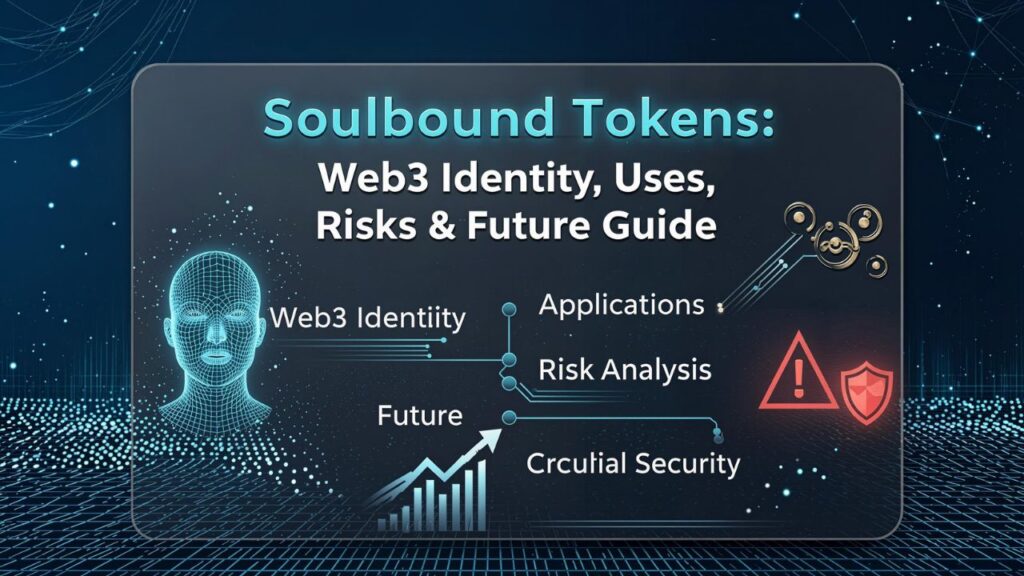
What Are soulbound tokens?
soulbound tokens are non-transferable digital tokens linked to a blockchain account, identity, institution, or community profile. They can represent things like academic degrees, job history, event attendance, professional licenses, community roles, governance rights, or trust signals.
The term “soulbound” originally comes from gaming, where certain items are permanently tied to the character who earns them. In Web3, the idea is similar. If a credential is meant to prove something about you, it should not be something another person can simply buy from you.
A Simple Definition
A soulbound token is a blockchain-based credential that is attached to a specific wallet or account and cannot be freely transferred like a normal NFT or cryptocurrency.
That makes it useful for records that need authenticity. A university diploma loses meaning if anyone can purchase it secondhand. A professional license becomes dangerous if it can be sold. A reputation badge becomes meaningless if a wealthy user can buy hundreds of them.
How They Differ From Regular NFTs
Regular NFTs are usually transferable. You can buy, sell, gift, or trade them on marketplaces. That works well for art, collectibles, game assets, tickets, memberships, and digital property.
Soulbound assets work differently. Their value comes from being connected to the original holder. If a wallet has a token proving that its owner completed a course, attended a governance meeting, passed identity verification, or earned a community role, that token only matters if it stays with the person or account that earned it.
Ethereum’s ERC-5192 standard describes a minimal interface for “soulbound” NFTs and defines them as tokens bound to a single account.
Why soulbound tokens Matter
soulbound tokens matter because the internet has a trust problem. People can fake profiles, exaggerate credentials, manipulate reviews, buy followers, create bot accounts, and pretend to have experience they never earned.
Blockchain does not automatically solve trust, but it can create tamper-resistant records. When those records are non-transferable, they become more useful for identity, reputation, and verification.
The Problem With Transferable Reputation
Transferability is powerful for markets, but it is terrible for personal reputation. If a medical license, university certificate, voting right, or trust score can be bought, the credential stops proving anything meaningful.
This is why non-transferability matters. It allows digital records to behave more like real-world trust markers. A degree belongs to the graduate. A license belongs to the qualified professional. A voting credential belongs to the eligible member. A proof-of-participation badge belongs to the person who participated.
The Shift From Speculation to Trust
Much of crypto has been shaped by price movement. Tokens go up, tokens go down, and communities often form around financial upside. Soulbound design points toward a different kind of value: social value.
That does not mean every project using this idea is automatically useful. It means the design opens new possibilities for digital identity, professional credibility, online communities, and decentralized governance.
How soulbound tokens Work
At a technical level, soulbound tokens are usually smart-contract-based tokens with restrictions that prevent normal transfers. They may be minted by an issuer, assigned to a wallet, displayed in a profile, verified by applications, and sometimes revoked or updated depending on the design.
There is not only one way to build them. Different standards and implementations handle non-transferability, revocation, expiration, privacy, and account recovery differently.
The Role of the Issuer
The issuer is the person, organization, protocol, DAO, school, employer, platform, or institution that creates and assigns the token.
For example:
- A university could issue a graduation credential
- A conference could issue attendance proof
- A DAO could issue membership or contribution badges
- A company could issue employment verification
- A platform could issue identity verification credentials
- A training provider could issue skill certificates
The credibility of the token depends heavily on the credibility of the issuer. A diploma token from a recognized university means more than a random badge from an unknown wallet.
The Role of the Holder
The holder is the wallet, account, or “Soul” that receives the token. The holder may use it to prove something to websites, decentralized apps, employers, communities, lenders, or governance systems.
The holder might not always want every credential to be public. This is where privacy becomes important. A person may want to prove they are over 18 without revealing their birthdate, or prove they completed KYC without exposing their full identity on-chain.
The Role of Smart Contracts
Smart contracts define the rules. They can control whether a token is transferable, revocable, burnable, visible, expired, locked, or linked to another identity system.
Some implementations are simple: the token cannot move. Others are more advanced: the issuer can revoke it, the holder can reject it, or the credential can expire after a certain date.
Ethereum’s ERC-5727 proposal, for example, describes an interface for semi-fungible soulbound tokens that can represent identity, credentials, affiliations, and reputation while supporting lifecycle management features.
![Image: Infographic showing issuer, holder, smart contract, verification app, and privacy layer in a soulbound token system. Alt text: infographic explaining how soulbound tokens work]
Real-World Uses for soulbound tokens
soulbound tokens become interesting when they move from theory into practical use. Their strongest use cases involve proof, trust, access, and reputation.
They are not ideal for everything. If something should be traded, rented, sold, or gifted, a normal transferable token may be better. But if something should stay tied to a person, account, or institution, non-transferable tokens make more sense.
Education and Academic Credentials
Education is one of the clearest use cases. Schools, universities, bootcamps, and online academies could issue non-transferable credentials for degrees, diplomas, course completions, research awards, or attendance.
This could help employers verify qualifications faster. Instead of contacting a registrar or checking a PDF certificate, an employer could verify the credential cryptographically.
The challenge is adoption. A credential only becomes useful if recognized institutions issue it and employers trust it.
Professional Certifications
Professional licenses and certificates often need verification. A blockchain-based non-transferable credential could help prove that someone is a licensed engineer, certified accountant, cybersecurity professional, medical specialist, or trained technician.
This does not remove the need for legal regulators or professional bodies. It simply gives them a stronger digital format for issuing and checking credentials.
DAO Governance
Many DAOs struggle with governance because token-based voting can become plutocratic. In plain English, people with more tokens can have more power, even if they have contributed less to the community.
Non-transferable reputation badges could help DAOs recognize real contributions, long-term participation, technical expertise, moderation work, or community service. The original decentralized society paper discusses how non-transferable credentials could support sybil-resistant governance and decentralization.
Event Attendance and Community Proof
Proof-of-attendance tokens already exist in crypto culture, but transferable attendance badges can be sold or moved. A non-transferable event credential has a clearer meaning: this wallet actually attended or participated.
Communities could use these credentials to reward early members, grant access to private groups, recognize volunteers, or build reputation over time.
KYC and Identity Verification
Some platforms use soulbound-style tokens to show that a user completed identity verification. Binance Account Bound, or BAB, is a real example. Binance describes BAB tokens as credentials for users who have passed KYC, with three key properties: they are non-transferable, cannot be transferred between addresses, and are revocable.
That does not mean every user wants identity linked to a wallet. It does show how non-transferable credentials can be used in real products.
Credit, Lending, and Reputation
DeFi lending often depends on collateral because protocols do not know who borrowers are or whether they are trustworthy. Reputation-based credentials could someday help support undercollateralized lending, though this area is still sensitive and risky.
A borrower’s on-chain record might include repayment history, verified employment, DAO contribution history, or business credentials. But financial reputation systems must be designed carefully to avoid discrimination, privacy abuse, and permanent punishment for past mistakes.
Benefits of soulbound tokens
The main benefit of soulbound tokens is that they make digital trust harder to fake. They can help people and organizations prove facts without relying only on screenshots, PDFs, passwords, or centralized databases.
That said, the benefits depend on design. A poorly built credential system can create more problems than it solves.
Stronger Digital Reputation
Online reputation today is scattered. A person may have LinkedIn endorsements, GitHub commits, university records, Twitter history, Discord roles, and private work experience across many platforms. None of these systems speak the same language.
Non-transferable credentials could help bring reputation into a portable format. A developer, artist, student, researcher, or community organizer could carry proof of work across platforms.
Better Protection Against Fake Credentials
Fake certificates and inflated resumes are a real problem. Blockchain credentials can make verification easier because records can be checked directly against the issuer’s smart contract.
A forged PDF may look convincing, but a fake on-chain credential from a recognized issuer would be harder to pass off if employers know how to verify it.
More Meaningful Community Membership
Communities often want to know who has actually contributed. A non-transferable badge can represent real participation, not just purchased access.
For example, a DAO could recognize people who voted consistently, reviewed proposals, wrote documentation, helped new members, tested products, or attended important meetings.
Reduced Speculation
Because these tokens are not designed for trading, they are less likely to become pure speculative assets. That can help communities focus on contribution, access, and identity rather than floor prices.
This is not a guarantee. People can still speculate around systems that use credentials, but the token itself is not meant to be sold like a collectible.
Risks and Concerns
The strongest arguments for soulbound tokens are also where the biggest risks appear. If a credential is permanent, visible, and linked to identity, it can become powerful. But power can be misused.
The same tool that proves a degree could also expose sensitive information. The same reputation system that rewards contribution could also create unfair exclusion. The same identity token that blocks bots could also reduce anonymity.
Privacy Problems
Public blockchains are transparent by default. If personal credentials are placed directly on-chain, they may reveal too much about someone’s life, work, beliefs, finances, education, health, location, or associations.
This is why many experts argue that privacy-preserving approaches are essential. Some credentials may need to be off-chain, encrypted, selective, or proven through zero-knowledge methods rather than openly displayed.
A 2022 Indicio article argued that soulbound tokens were not originally designed for privacy in the same way verifiable credentials were, which highlights an important debate in digital identity design.
Permanent Stigma
What happens if someone receives a negative credential? What if a platform issues a “bad actor” token unfairly? What if a person changes, grows, or deserves a second chance?
Permanent reputation can become dangerous if it creates lifelong stigma. Any serious system needs dispute resolution, revocation, appeal, expiration, and human judgment.
Wallet Loss and Recovery
If a credential is bound to a wallet, losing that wallet can be painful. People lose seed phrases, devices, keys, and access to accounts. If your diplomas, licenses, memberships, and reputation are all linked to one wallet, recovery becomes essential.
Smart contract wallets, social recovery, issuer reissuance, and account abstraction can help, but the user experience still needs improvement.
Issuer Abuse
A token issuer may make mistakes or act unfairly. A platform could revoke credentials without due process. A government or corporation could use non-transferable credentials for surveillance or exclusion.
This is why governance matters. A good system needs transparent rules, user consent, appeal paths, and privacy safeguards.
soulbound tokens and Decentralized Identity
soulbound tokens are often discussed alongside decentralized identity because both ideas aim to give people better control over digital proof. But they are not identical.
Decentralized identity is a broader field. It includes decentralized identifiers, verifiable credentials, cryptographic proofs, wallets, privacy tools, and trust frameworks. Soulbound design is one possible piece of that larger puzzle.
Digital Identity Without a Single Gatekeeper
Today, identity is often controlled by centralized platforms. Your social profile belongs to a social network. Your work history lives on a career platform. Your academic records sit inside institutional databases. Your financial reputation is held by credit bureaus and banks.
Decentralized identity aims to make identity more portable. Instead of starting from zero on every platform, users could carry trusted credentials across apps and communities.
Where SBTs Fit
Soulbound credentials can act as visible or verifiable signals inside a decentralized identity system. They may show that a wallet belongs to a verified user, a graduate, a contributor, a voter, an employee, or a community member.
However, not every identity credential should be public or permanent. Some information is better handled through private verifiable credentials, selective disclosure, or zero-knowledge proofs.
The Privacy-Friendly Direction
The future may not be about putting everything on-chain. More likely, the strongest systems will combine on-chain anchors with off-chain private data.
A user could prove they have a credential without revealing all details. For example, they could prove they are a certified professional without revealing their full certificate number, home address, or unrelated credentials.
Technical Standards and Examples
The soulbound idea has inspired several Ethereum standards and real-world experiments. These standards do not all do the same thing, but they show how developers are trying to define non-transferable tokens in practical ways.
ERC-5192 is one of the best-known examples because it offers a minimal way to mark ERC-721 tokens as locked.
ERC-5192
ERC-5192 is called “Minimal Soulbound NFTs.” It extends EIP-721 and provides a simple interface for locked tokens. A locked token cannot be transferred.
This simplicity is useful because developers can build non-transferable NFT-style credentials without reinventing every part of the token standard.
ERC-5727
ERC-5727 focuses on semi-fungible soulbound tokens and includes richer lifecycle features. Its description includes identity, credentials, affiliations, and reputation, along with functions that can support governance, delegation, expiration, and recovery.
This is useful for more complex systems where credentials may not be one-size-fits-all.
Binance Account Bound Token
Binance Account Bound token is one of the most visible real-world examples. Binance describes it as an optional token for users who have completed identity verification, with Binance’s role limited to issuing the token upon request for eligible verified users.
The BAB example shows how a major exchange can use a non-transferable credential to represent account verification without making the token itself a tradable asset.
How Businesses Could Use soulbound tokens
For businesses, soulbound tokens are interesting because they can reduce fraud, improve verification, and create more durable relationships with users, employees, partners, and customers.
But businesses must be careful. A credential system that ignores privacy or consent can damage trust quickly.
Hiring and Professional Screening
Employers could verify degrees, certifications, work experience, training completions, and professional memberships faster. Candidates could share trusted credentials without sending piles of documents.
This could reduce fake resumes and speed up hiring, especially in industries where certification matters.
Customer Loyalty
A brand could issue non-transferable loyalty credentials based on long-term participation, not just spending. For example, a customer might receive recognition for attending events, contributing feedback, joining community programs, or supporting early product launches.
Because the credential cannot be sold, it can represent genuine relationship history.
Compliance and Access Control
Some products require eligibility checks. A business could use private credential proofs to confirm that users meet certain requirements without collecting unnecessary personal data every time.
The safest approach would avoid exposing sensitive details publicly. The goal should be verification with minimal disclosure.
How Creators and Communities Could Use Them
Creators, artists, educators, and community builders can use non-transferable credentials to recognize real participation. This is especially useful in online spaces where attention is easy to fake.
A community badge that cannot be bought has more meaning than one available on an open marketplace.
Recognizing True Supporters
Creators could issue badges to early supporters, course graduates, event participants, beta testers, patrons, or collaborators. These tokens could unlock future access, private rooms, voting rights, or special recognition.
Building Portable Reputation
A community moderator, open-source contributor, researcher, or educator could build a track record across platforms. Instead of reputation being trapped in one app, it could become easier to verify across the wider web.
Preventing Bot Manipulation
Communities often struggle with bots and fake accounts. Non-transferable credentials can help identify users with a history of real participation.
They are not a perfect anti-bot solution, but they can make manipulation more expensive and less effective.
What Makes a Good Soulbound System?
Not every non-transferable token is useful. A good system needs more than a smart contract. It needs social trust, thoughtful design, privacy protection, and clear rules.
Before trusting or building around these tokens, users and organizations should ask practical questions.
A Good System Should Be Clear
People should understand:
- Who issued the token
- What the token proves
- Whether it can be revoked
- Whether it expires
- Whether it reveals public information
- Whether the holder consented
- How mistakes are corrected
- What happens if the wallet is lost
Confusing credentials create risk. Clear credentials create trust.
A Good System Should Respect Consent
Users should not receive public identity-linked credentials without understanding the consequences. Consent matters, especially if the token reveals something sensitive.
Some credentials should be private by default. Others should be rejectable, revocable, or hidden unless the user chooses to disclose them.
A Good System Should Allow Recovery
People lose access. A realistic identity system must prepare for that. Recovery might involve issuer reissuance, social recovery, smart accounts, multi-signature wallets, or verified migration to a new wallet.
Without recovery, users may be afraid to rely on soulbound systems for important credentials.
Common Misunderstandings
Because soulbound tokens are still a young concept, misunderstandings are common. Some people treat them as magic identity tools. Others dismiss them as permanent surveillance. The truth is more nuanced.
They are a design pattern. Whether they help or harm depends on how they are built and used.
They Are Not Always Permanent
Some people assume every soulbound token lasts forever. That is not always true. A system can include revocation, expiration, replacement, or burning mechanisms.
For example, a license might expire after one year. A membership token might be revoked if the member leaves. A KYC credential might be updated after identity checks change.
They Are Not Always Public Identity
A soulbound credential does not have to reveal a real name. It might be linked to a pseudonymous wallet. It might only prove membership, participation, or eligibility.
Still, combining many credentials can reveal patterns. Even pseudonymous identity can become identifiable over time.
They Are Not a Replacement for Human Trust
Technology can help verify records, but it cannot replace judgment. A token can prove that something was issued. It cannot always prove that the issuing institution is trustworthy, that the credential is meaningful, or that the holder is still qualified.
Verification is not the same as wisdom.
The Future of soulbound tokens
The future of soulbound tokens will likely depend on whether builders solve three hard problems: privacy, recovery, and real-world trust.
If those problems are handled well, non-transferable credentials could become part of digital identity infrastructure. If they are handled poorly, users may reject them as invasive or risky.
More Private Credentials
The strongest future versions may use zero-knowledge proofs and selective disclosure. This would let users prove specific facts without exposing everything.
For example, a person could prove they completed a course, passed KYC, or belongs to a professional group without making their whole identity public.
Better Wallets and Account Recovery
Wallets need to become safer and easier. Mainstream users cannot be expected to protect their entire identity with one fragile seed phrase.
Smart accounts, social recovery, hardware security, and trusted reissuance processes will likely play a major role.
Stronger Links With Real Institutions
For this idea to reach mainstream value, trusted issuers must participate. Universities, licensing bodies, employers, event organizers, DAOs, nonprofits, and regulated platforms all have possible roles.
The technology is only part of the story. The social layer determines whether a credential matters.
FAQ
What are soulbound tokens?
soulbound tokens are non-transferable blockchain tokens that represent credentials, identity signals, reputation, affiliations, or achievements. They are designed to stay linked to the wallet or account that earned or received them.
Can soulbound tokens be sold?
Usually, no. Their main purpose is non-transferability. If a credential could be sold, it would lose much of its meaning as proof of identity, achievement, membership, or reputation.
Are soulbound tokens the same as NFTs?
They can be built using NFT-like standards, but they are not the same as ordinary NFTs. Normal NFTs are usually transferable. Soulbound assets are designed to stay attached to one account.
Who created the idea?
The idea became widely known through the 2022 paper Decentralized Society: Finding Web3’s Soul by Vitalik Buterin, Puja Ohlhaver, and E. Glen Weyl. The paper described non-transferable tokens for commitments, credentials, and affiliations.
What are the best use cases?
Strong use cases include academic credentials, professional certifications, DAO reputation, proof of attendance, identity verification, community roles, licenses, and contribution records.
Are they safe for privacy?
They can create privacy risks if sensitive information is public, permanent, or linked to a real identity. Safer systems should use consent, selective disclosure, revocation, encryption, or zero-knowledge proofs.
What happens if I lose my wallet?
That depends on the system. Some tokens may be reissued, recovered through smart wallets, or revoked and replaced. Any serious credential system needs a clear recovery process.
Can a soulbound token be revoked?
Some designs allow revocation, while others may not. Binance’s BAB token, for example, is described as revocable by the issuer.
Are soulbound tokens already being used?
Yes, but adoption is still early. Binance Account Bound token is a notable example of a soulbound-style credential for verified Binance users. Ethereum standards such as ERC-5192 also show how developers are formalizing non-transferable token behavior.
Conclusion
soulbound tokens are one of the more human ideas to come out of Web3 because they focus less on price and more on proof. They ask a simple but powerful question: what if digital credentials could be trusted, portable, and harder to fake?
The answer could reshape education, hiring, governance, events, compliance, communities, and online reputation. A wallet could become more than a place to hold assets. It could become a living record of participation, learning, contribution, and trust.
But the idea must be handled carefully. Identity is sensitive. Reputation can be misused. Permanent records can become unfair. Public credentials can expose more than people realize. The best future for this technology will not be the most public or the most permanent one. It will be the one that balances verification with privacy, accountability with consent, and innovation with human dignity.