Introduction
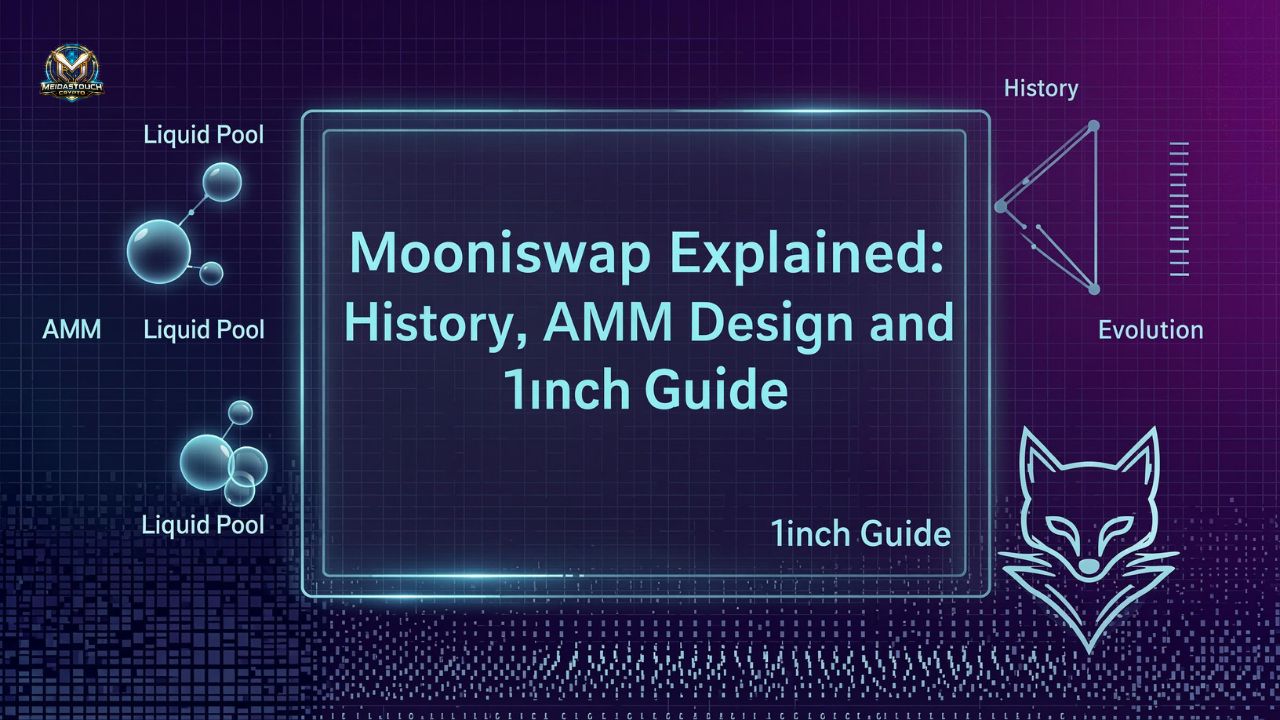
Crypto moves so fast that some projects become “old history” before many people even understand what they were. mooniswap is one of those DeFi names that still appears in searches, wallets, old guides, liquidity records, and 1inch discussions.
At its core, Mooniswap was an automated market maker created by the 1inch team. It was designed to improve the way liquidity providers earned from swaps by using a special feature called virtual balances. The idea was simple but clever: reduce how much value arbitrage traders could pull away immediately after price changes and redirect more of that value toward liquidity providers.
Today, Mooniswap should be understood mainly as a legacy DeFi protocol. 1inch later moved toward its broader Liquidity Protocol and modern swap aggregation products, while the original Mooniswap codebase is now archived and read-only on GitHub.
Table of Contents
- What Is Mooniswap?
- Why Mooniswap Was Created
- How Mooniswap Worked
- Mooniswap and 1inch: The Connection
- Mooniswap vs Uniswap and Other AMMs
- Fees, Liquidity Pools, and Provider Rewards
- Risks, Security, and Current Status
- Should You Still Use Mooniswap Today?
- Project Background and Financial Insight
- FAQ
- Conclusion
What Is Mooniswap?
Mooniswap was a decentralized automated market maker, or AMM, launched by the 1inch team in August 2020. It allowed users to swap Ethereum-based tokens through liquidity pools rather than through a traditional order book. The protocol used the constant-product AMM model, similar to early Uniswap-style exchanges, but added virtual balances as its main innovation.
In simple language, an AMM is a smart contract system where users trade against pools of tokens. Liquidity providers deposit tokens into those pools. Traders use the pool to swap one token for another. Fees and pricing rules decide how value moves between traders, liquidity providers, and arbitrageurs.
Mooniswap tried to solve one painful issue in early DeFi: liquidity providers often lost part of the value created by price differences because arbitrage bots corrected pool prices quickly. Mooniswap slowed part of that process using virtual balances, giving liquidity providers a better chance to capture value that might otherwise go to arbitrage traders.
Why Mooniswap Was Created
The early DeFi market was exciting but messy. Uniswap had shown that automated token swaps could work without centralized exchanges. Still, the model had weaknesses. One of the biggest was the relationship between liquidity providers and arbitrageurs.
When token prices changed outside an AMM pool, arbitrage traders could buy underpriced assets or sell overpriced ones until the pool matched the outside market. That helped keep prices accurate, but it also meant liquidity providers could lose some potential value.
The 1inch team introduced Mooniswap as an AMM that would redirect more of that value back to liquidity providers. Its launch article described the protocol as a way to redistribute earnings to liquidity pools, capitalize on user slippage, and protect traders from front-running attacks.
That idea sounded technical, but the human reason was easy to understand. People providing liquidity wanted a fairer outcome. They were taking risk by depositing tokens. Mooniswap aimed to make that risk more worthwhile.
How Mooniswap Worked
Mooniswap used a constant-product formula, the same broad AMM family made famous by Uniswap. In a simple two-token pool, the AMM keeps a mathematical relationship between the token balances. When a trader buys one token, the pool balance changes, and the price adjusts.
The unique part was virtual balances. Instead of instantly exposing the full new pool balance after a trade, Mooniswap used delayed virtual balances. OpenZeppelin’s audit summary described Mooniswap as a constant-product AMM created by 1inch that used virtual balances to reduce liquidity providers’ losses to arbitrageurs.
Virtual Balances in Simple Words
Imagine a pool has ETH and USDC. A large swap changes the pool price. In a normal AMM, arbitrage bots may immediately trade against that new price. With Mooniswap, the pool’s effective balance changed more gradually.
This delay made arbitrage less instantly profitable. Instead of one bot capturing the whole opportunity quickly, some of the value stayed inside the pool. That could improve liquidity provider returns.
Why the Delay Mattered
The Mooniswap whitepaper explained that virtual balances were designed to blunt the price impact of short-term trading volume slippage, allowing profits that would normally be captured by arbitrageurs to be captured by liquidity providers instead.
In everyday terms, Mooniswap tried to make the pool less easy for bots to drain after sudden price moves.
![Image 2: Infographic showing Mooniswap flow: trader swap, pool balance change, virtual balance delay, arbitrage reduction, liquidity provider reward]
Mooniswap and 1inch: The Connection
Mooniswap was built by the 1inch team. 1inch began as a DEX aggregator, meaning it searched across decentralized exchanges to find better token swap routes. Today, 1inch describes itself as a DeFi swap platform that aggregates liquidity across 13+ chains and focuses on better swap rates, cross-chain swaps, MEV protection, wallet tools, and APIs.
Mooniswap was part of that early 1inch ecosystem. It gave 1inch its own AMM liquidity source rather than relying only on external DEXes.
Over time, Mooniswap became tied to the broader 1inch Liquidity Protocol. Several industry profiles describe Mooniswap as the earlier name or predecessor of 1inch’s liquidity protocol, and Messari describes it as now obsolete.
That is important for anyone researching the topic today. Mooniswap is not the main current 1inch product. It is a historical protocol that helped shape later liquidity ideas.
Mooniswap vs Uniswap and Other AMMs
Mooniswap was often compared to Uniswap because both used AMM pools instead of order books. The difference was not that Mooniswap invented AMMs. The difference was how it tried to handle arbitrage and slippage.
| Feature | Mooniswap | Early Uniswap-Style AMMs |
|---|---|---|
| Trading model | Automated market maker | Automated market maker |
| Liquidity source | User-funded pools | User-funded pools |
| Main innovation | Virtual balances | Simpler constant-product pricing |
| Goal | Redirect more arbitrage value to LPs | Provide open token swaps |
| Status today | Legacy / obsolete | Uniswap continues as a major DEX ecosystem |
| Created by | 1inch team | Uniswap Labs ecosystem |
Where Mooniswap Felt Different
Mooniswap focused on liquidity provider economics. It tried to reduce the amount of value lost when arbitrageurs corrected prices. For people deeply involved in DeFi liquidity, that was an interesting idea.
Where Uniswap Had the Advantage
Uniswap had stronger brand recognition, deep liquidity, and broad developer adoption. Even if Mooniswap had a smart mechanism, liquidity is the life of an exchange. Traders usually go where pools are deepest, routes are best, and integrations are strongest.
Fees, Liquidity Pools, and Provider Rewards
Mooniswap pools allowed liquidity providers to deposit tokens and earn from trading activity. In DeFi, liquidity providers usually earn a portion of swap fees. Their hope is that fees and incentives outweigh risks such as impermanent loss, gas costs, and token price volatility.
Mooniswap’s special pitch was that virtual balances could improve LP returns by reducing value leakage to arbitrage. The 1inch launch material and later audit descriptions both frame this as a core part of the design.
Liquidity Provider Example
Suppose a user deposited equal values of ETH and USDC into a pool. Traders used that pool to swap between ETH and USDC. The liquidity provider received pool shares and earned from trading activity.
If ETH moved sharply on outside exchanges, arbitrage traders would normally correct the pool price. Mooniswap tried to slow that immediate correction through virtual balances, potentially leaving more value for liquidity providers.
The Catch
This did not remove risk. Liquidity providers could still face:
- Impermanent loss
- Smart contract bugs
- Gas fees
- Token volatility
- Low pool volume
- Rug-pull or scam-token risk
- Poor liquidity exit conditions
- Front-end or approval risks
A better AMM formula can help with one part of DeFi, but it does not make liquidity provision safe.
Risks, Security, and Current Status
Mooniswap should be approached carefully today because it is a legacy protocol. The original GitHub repository is archived and read-only, which means it is no longer maintained in the same way active codebases are.
Security audits were performed around Mooniswap and 1inch Liquidity Protocol work. OpenZeppelin published an audit of the 1inch Liquidity Protocol in January 2021, and ConsenSys Diligence also documented Mooniswap V2 as a legacy system.
That does not mean users should blindly interact with old contracts. Audits reduce risk; they do not eliminate it.
Main Safety Concerns
If someone finds an old Mooniswap link, pool, or interface, they should think carefully before connecting a wallet. Old DeFi front ends, cloned websites, outdated contracts, and fake token pools can all create risk.
Important safety steps include:
- Verify the official contract address from trusted sources
- Avoid unknown links from social media
- Use a wallet with limited funds for research
- Check token approvals before and after interacting
- Avoid infinite approvals unless fully necessary
- Confirm whether the protocol is still active
- Understand that old pools may have poor liquidity
- Never assume a legacy DeFi protocol is safe because it once was popular
Should You Still Use Mooniswap Today?
For most normal users, Mooniswap is better treated as DeFi history than as a fresh platform to use. The modern 1inch ecosystem has moved toward current aggregation, cross-chain swaps, wallet tools, APIs, and other products. The official 1inch site now highlights swap aggregation across 13+ chains, MEV protection, portfolio tools, and broader DeFi infrastructure rather than Mooniswap as a current flagship product. (1inch)
That does not make Mooniswap irrelevant. It remains useful for:
- Understanding AMM history
- Studying virtual balances
- Reviewing early DeFi liquidity experiments
- Researching 1inch’s product evolution
- Learning about LP economics
- Comparing AMM design models
If your goal is education, Mooniswap is worth studying. If your goal is active trading or liquidity provision, use current platforms, current audits, current liquidity data, and current official links.
Mooniswap and the 1INCH Token
Mooniswap is often discussed near the 1INCH token because both came from the 1inch ecosystem. The 1INCH token launched in December 2020 alongside governance and broader community participation. Messari describes the token launch and the later DAO structure as part of 1inch’s evolution after Mooniswap.
Still, Mooniswap itself should not be confused with a separate “Mooniswap coin.” The main ecosystem token connected to 1inch is 1INCH.
That distinction matters because crypto search results can be messy. Some websites may use old names, token pages, clone pages, or speculative content. Always confirm the asset, contract address, and official source before making any transaction.
Mooniswap in DeFi History
Mooniswap arrived during a very active DeFi period in 2020. That era produced huge interest in automated market makers, yield farming, liquidity mining, DEX aggregation, governance tokens, and on-chain trading.
The protocol’s contribution was not that it became the largest AMM. Its contribution was that it pushed the conversation around liquidity provider fairness. Virtual balances were a design attempt to deal with a real AMM problem: arbitrage profits and impermanent loss.
Some ideas in DeFi disappear completely. Others survive as lessons. Mooniswap belongs more to the second group. Even if the original product is now legacy, the problem it tried to solve still matters.
Common Mistakes People Make When Researching Mooniswap
The biggest mistake is assuming every old guide is still current. DeFi guides from 2020 or 2021 can contain outdated links, old screenshots, changed interfaces, old farms, and inactive pools.
Other mistakes include:
- Thinking Mooniswap is a new token
- Confusing toman-style naming? No, this is a DeFi protocol, not a currency
- Using unofficial front ends
- Ignoring smart contract approval risk
- Assuming archived code means active maintenance
- Treating old APY claims as current
- Not checking liquidity depth
- Forgetting gas costs
- Confusing 1inch aggregator swaps with Mooniswap pools
- Ignoring impermanent loss
A calm rule helps: research first, connect wallet last.
Project Background and Financial Insight
Mooniswap was created by the 1inch team, whose wider ecosystem grew out of DEX aggregation. 1inch’s current platform describes itself as a swap aggregator that searches liquidity across multiple networks to improve swap rates, with reported large-scale usage metrics such as hundreds of billions in swap volume and millions of connected wallets.
Financially, Mooniswap is best understood as an early experiment in liquidity-provider economics. It tried to change who captured value after trades moved pool prices.
For liquidity providers, that mattered because AMM returns are not only about fee percentage. Real returns depend on:
- Trading volume
- Pool depth
- Asset volatility
- Impermanent loss
- Token incentives
- Gas fees
- Smart contract risk
- Arbitrage behavior
- Exit liquidity
- Market direction
Mooniswap tried to improve one part of that equation. It did not remove the rest.
FAQ
What is Mooniswap?
Mooniswap was an automated market maker created by the 1inch team. It used liquidity pools and virtual balances to try to redirect more arbitrage value toward liquidity providers.
Is Mooniswap still active?
Mooniswap is best treated as a legacy protocol today. Messari describes it as obsolete, and the original GitHub repository is archived and read-only.
Who created Mooniswap?
Mooniswap was created by the 1inch team, the same ecosystem known for DEX aggregation and DeFi swap routing.
What made Mooniswap different?
Its main feature was virtual balances. This mechanism delayed balance updates in a way designed to reduce arbitrage profits and improve liquidity provider outcomes.
Is Mooniswap the same as 1inch?
No. Mooniswap was an AMM product from the 1inch ecosystem. 1inch today is broader, with aggregation, cross-chain swaps, wallet tools, portfolio tools, APIs, and other DeFi products.
Did Mooniswap have its own token?
Mooniswap did not become known as a separate major token brand. The main token connected to the 1inch ecosystem is 1INCH.
Is it safe to use old Mooniswap links?
Be very careful. Old links, fake interfaces, low-liquidity pools, and outdated approvals can be risky. Always verify official sources and avoid connecting valuable wallets to old DeFi sites.
What are virtual balances?
Virtual balances are a mechanism that changes how pool balances are reflected after trades. In Mooniswap, they were designed to reduce immediate arbitrage extraction and give liquidity providers better economics.
Why did Mooniswap matter?
Mooniswap mattered because it explored a real AMM problem: how to reduce value leakage from liquidity providers to arbitrageurs. Even as a legacy project, it remains useful for DeFi education.
What replaced Mooniswap?
Mooniswap evolved into or was replaced by broader 1inch Liquidity Protocol discussions, while 1inch’s current public product focus is its modern aggregation and DeFi ecosystem.
Conclusion
Mooniswap was an important early DeFi experiment from the 1inch team. It took the familiar AMM model and added virtual balances to improve liquidity provider economics by slowing how arbitrage value was captured.
Today, Mooniswap is not best viewed as a hot new DEX. It is better understood as a legacy protocol and a useful chapter in AMM history. Its ideas still matter because DeFi continues to wrestle with slippage, MEV, arbitrage, liquidity incentives, and fair returns for liquidity providers.
If you are researching Mooniswap, study it carefully, check current sources, and avoid old links unless you know exactly what you are doing. As a learning topic, it is genuinely interesting. As an active wallet interaction, it deserves caution.