
The sun produces more energy in one second than humanity has consumed in its entire recorded history. It does this through a process called nuclear fusion — the same process that scientists have been trying to replicate on Earth for over seventy years. A fusion reactor is the machine designed to harness that process, and after decades of incremental progress, the field is experiencing a genuine acceleration that has physicists, engineers, and energy investors paying very close attention.
Understanding fusion energy isn’t just an academic exercise. The decisions being made in laboratories and government funding offices right now will shape the global energy landscape for the rest of this century. Whether you’re a curious reader, a student, a policy watcher, or someone who simply wants to understand what all the recent headlines mean, this guide covers the science, the engineering, the breakthroughs, and the honest challenges that still stand between today’s experiments and tomorrow’s power grid.
Fusion power has long carried the reputation of being perpetually thirty years away. That reputation is changing — not because the problems have disappeared, but because the pace of progress has genuinely shifted. Private investment has surged, government programs have produced landmark results, and the scientific community’s confidence in a commercial timeline has grown measurably. The story of the fusion reactor is no longer just a story about what might be possible. It’s becoming a story about what’s actually happening.
What Is Fusion and Why Does It Matter?
To understand the fusion reactor, you first need to understand the underlying physics. What is fusion, at its most basic? It’s the process by which two light atomic nuclei combine to form a heavier nucleus, releasing a significant amount of energy in the process. This is the opposite of fission — the process used in conventional nuclear power plants — which splits heavy atoms apart.
The most promising fusion reaction for energy production involves two isotopes of hydrogen: deuterium and tritium. When these nuclei fuse under extreme conditions, they produce helium and a high-energy neutron, releasing approximately 17.6 million electron volts of energy per reaction. To put that in perspective, a single gram of deuterium-tritium fuel contains roughly the energy equivalent of ten tons of coal.
The Physics Behind the Reaction
How does nuclear fusion work in practice? The challenge is that atomic nuclei carry positive electrical charges, which means they naturally repel each other. To overcome this repulsion — called the Coulomb barrier — you need to bring the nuclei close enough together that the strong nuclear force takes over. That requires temperatures of approximately 100 million degrees Celsius, roughly seven times hotter than the core of the sun.
At those temperatures, matter exists in a state called plasma — a superheated gas in which electrons have been stripped from their atoms, leaving a soup of charged particles. Containing and sustaining that plasma long enough and densely enough to produce more energy than you put in is the central engineering challenge of fusion research.
The condition for net energy gain is described by the Lawson criterion, which requires a sufficient combination of plasma temperature, density, and confinement time. Meeting all three simultaneously, consistently, and at scale is what separates a laboratory experiment from a working nuclear fusion reactor.
The Two Main Approaches to Fusion Confinement
Scientists have pursued several approaches to the confinement problem, but two have emerged as the dominant pathways: magnetic confinement and inertial confinement. Both aim to achieve the same goal — holding plasma at fusion conditions long enough to extract net energy — but they do so through fundamentally different methods.
Magnetic Confinement: The Tokamak Design
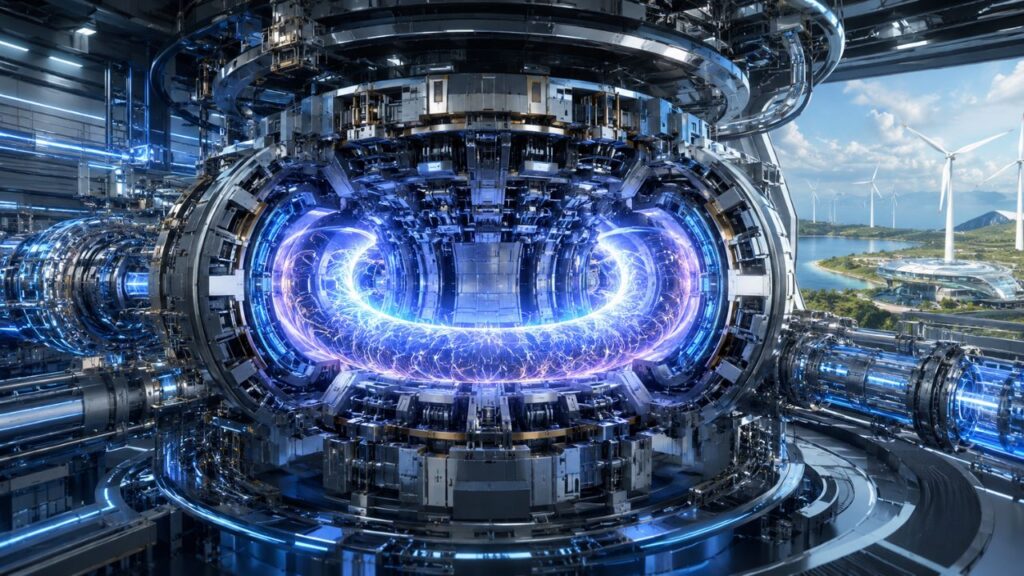
The tokamak is the most widely studied magnetic confinement device and the basis for the largest international fusion reactor project currently under construction. The design uses powerful magnetic fields — generated by superconducting coils — to confine plasma in a donut-shaped chamber called a torus. The magnetic fields act as an invisible bottle, preventing the superheated plasma from touching the reactor walls.
The tokamak concept originated in the Soviet Union in the 1950s and has been refined continuously since. Modern tokamaks use superconducting magnets cooled to near absolute zero, creating magnetic fields strong enough to contain plasma at temperatures that would vaporize any physical material. The engineering involved is extraordinary — you’re simultaneously managing the coldest and hottest things on Earth within the same machine.
ITER — the International Thermonuclear Experimental Reactor — is the world’s largest tokamak, currently under construction in southern France. A collaboration between 35 nations including the US, EU, China, Russia, Japan, South Korea, and India, ITER aims to demonstrate a fusion gain of Q=10, meaning it will produce ten times more energy than it consumes. It represents the most ambitious international science project since the International Space Station.
Inertial Confinement: Lasers and Implosion
The second major approach uses powerful lasers to compress and heat a tiny pellet of fusion fuel so rapidly that fusion occurs before the plasma has time to disperse. This is inertial confinement fusion, and it’s the approach used at the National Ignition Facility (NIF) at Lawrence Livermore National Laboratory in California.
In December 2022, NIF achieved a landmark result that made global headlines: for the first time in history, a fusion experiment produced more energy from the fusion reactions than the laser energy delivered to the target. This fusion breakthrough — called ignition — was a genuine scientific milestone, even though the total energy balance (accounting for the energy needed to power the lasers themselves) remains negative. The significance lies in proving that the physics works at the scale required.
The China Laser Fusion Complex and Global Competition
Fusion energy news in recent years has increasingly featured China as a major player, and the scale of Chinese investment in this field is genuinely striking. The china laser fusion complex — formally known as the Shenguang (Divine Light) laser facility — represents one of the world’s most powerful laser systems dedicated to inertial confinement fusion research.
China’s approach to fusion research reflects a broader national strategy around energy security and technological leadership. The country operates multiple fusion programs simultaneously, including the EAST tokamak (Experimental Advanced Superconducting Tokamak) in Hefei, which has set multiple records for plasma confinement duration. In 2023, EAST sustained a plasma temperature of 120 million degrees Celsius for 403 seconds — a world record that demonstrated significant progress in the confinement time component of the Lawson criterion.
The Competitive Landscape in Fusion Research
The global fusion energy landscape has shifted from a purely collaborative scientific endeavor to something that also carries elements of technological competition. The United States, European Union, China, South Korea, and the United Kingdom all operate significant national fusion programs, and private investment has added a new dimension to the competitive environment.
Companies like Commonwealth Fusion Systems (CFS), TAE Technologies, Helion Energy, and General Fusion have collectively raised billions of dollars in private capital, each pursuing different technical approaches with the goal of reaching commercial fusion power ahead of the government-funded programs. Commonwealth Fusion Systems, a spinout from MIT, has demonstrated high-temperature superconducting magnets that could enable a much more compact tokamak design than ITER — potentially reaching commercial operation in the early 2030s.
The December 2022 Fusion Breakthrough: What It Actually Means
The NIF ignition result deserves careful examination, because the media coverage ranged from accurate to significantly overstated. Understanding what actually happened — and what it means for the path to commercial fusion power — requires separating the genuine scientific achievement from the practical distance still to travel.
What NIF achieved was target gain greater than one: the 192 laser beams delivered 2.05 megajoules of energy to the fusion target, and the resulting fusion reactions released 3.15 megajoules. That’s a gain of approximately 1.5 — more energy out than in, at the target level. This is the fusion breakthrough that physicists had been working toward for decades, and its scientific significance is real.
The Gap Between Ignition and a Power Plant
The honest context is that the NIF facility consumed approximately 300 megajoules of electrical energy to produce those 2.05 megajoules of laser energy — a wall-plug efficiency of less than one percent. The path from laboratory ignition to a commercially viable nuclear fusion reactor requires solving several additional engineering challenges:
- Driver efficiency — the lasers (or alternative drivers) need to be dramatically more efficient
- Repetition rate — a power plant needs to fire fusion targets many times per second, not once per day
- Target manufacturing — fusion targets need to be produced at scale and at low cost
- Tritium breeding — tritium is rare and must be produced within the reactor itself using lithium blankets
- Materials science — reactor components must withstand intense neutron bombardment over years of operation
None of these challenges are considered insurmountable by the scientific community, but each requires significant engineering development. The fusion energy breakthrough at NIF proved the physics; the engineering remains the work of the coming decades.
The Nuclear Fusion Diagram: Understanding Reactor Components
A nuclear fusion diagram of a tokamak reveals the extraordinary complexity of the machine. Understanding the key components helps clarify both the achievement and the remaining challenges.
The plasma chamber sits at the center, shaped like a hollow donut. Surrounding it are the toroidal field coils — superconducting magnets that generate the primary confining magnetic field — and the poloidal field coils, which shape and position the plasma within the chamber. A central solenoid drives the plasma current that generates an additional magnetic field component essential for confinement.
Key Systems in a Fusion Reactor
Beyond the magnetic system, a complete fusion reactor requires several additional systems working in concert:
- Heating systems — neutral beam injectors and radio-frequency heating raise the plasma to fusion temperatures
- Divertor — a component at the bottom of the plasma chamber that exhausts heat and helium ash produced by fusion reactions
- Blanket modules — surrounding the plasma chamber, these absorb neutron energy (converting it to heat) and breed tritium from lithium
- Cryogenic system — maintains the superconducting magnets at approximately 4 Kelvin (-269°C)
- Remote handling systems — because the reactor becomes radioactive during operation, all maintenance must be performed by robotic systems
The reactorfusion exchange of energy — from plasma to blanket to heat exchanger to turbine to electricity — follows the same basic thermodynamic pathway as a conventional power plant. The fusion reactor is, in a sense, an extraordinarily sophisticated way to boil water.
The Road to Commercial Fusion Power
The timeline question is the one that generates the most debate in the fusion energy community. The traditional joke — that commercial fusion is always thirty years away — has persisted because the technical challenges have consistently proven harder than optimistic projections suggested. But the current moment genuinely feels different to many researchers who have spent careers in the field.
Fusion energy news from the past five years has included the NIF ignition result, multiple plasma confinement records from EAST and other tokamaks, the demonstration of high-temperature superconducting magnets by Commonwealth Fusion Systems, and the announcement of Helion Energy’s power purchase agreement with Microsoft — the first commercial fusion power contract in history, targeting delivery by 2028.
What Needs to Happen Before Fusion Powers the Grid
The honest assessment of the path to commercial nuclear fusion energy involves several sequential milestones:
- Demonstration of sustained ignition — NIF achieved ignition once; consistent, repeatable ignition at high repetition rates is the next target
- Net energy gain at wall-plug level — the total energy balance, including all facility power consumption, must become positive
- DEMO-class reactor — a demonstration power plant that produces electricity at scale, likely in the 2040s under current government program timelines
- First commercial plants — private ventures aim for earlier timelines, with some targeting the 2030s
The fusion research community broadly agrees that the physics is understood well enough to proceed with confidence. The remaining uncertainties are primarily engineering and materials science challenges — difficult, but of a different character than the fundamental physics questions that dominated earlier decades.
[IMAGE: Timeline graphic showing the history of fusion milestones from 1952 to present, with projected future milestones including ITER first plasma, DEMO construction, and first commercial fusion power plant]
Frequently Asked Questions
Is nuclear fusion safe compared to conventional nuclear power?
Nuclear fusion is fundamentally safer than fission in several important ways. A fusion reactor cannot undergo a runaway chain reaction — if the plasma loses its precise conditions, the reaction simply stops. The fuel quantities involved at any moment are tiny (a few grams), so there’s no large inventory of reactive material that could be released in an accident. Fusion does produce radioactive materials through neutron activation of reactor components, but these are shorter-lived than fission waste and don’t include the long-lived isotopes that make fission waste management so challenging.
What fuel does a fusion reactor use, and how abundant is it?
The primary fuel for most fusion reactor designs is a mixture of deuterium and tritium. Deuterium occurs naturally in seawater at a ratio of about one part in 6,400 — making it effectively inexhaustible. Tritium is rare in nature but can be bred within the reactor itself by bombarding lithium with the neutrons produced by fusion reactions. Global lithium reserves are substantial, and the fuel requirements per unit of energy are so small that fusion fuel supply is not considered a long-term constraint.
How does fusion energy differ from solar and wind power?
Fusion energy would be a dispatchable power source — meaning it can produce electricity on demand, regardless of weather or time of day. This distinguishes it fundamentally from solar and wind, which are intermittent and require storage or backup capacity. A fusion power plant would operate continuously, like a conventional power plant, but without the carbon emissions of fossil fuels or the long-lived waste of fission. Many energy analysts see fusion as a potential complement to renewables rather than a competitor.
Why has fusion taken so long to develop?
The core challenge is that the conditions required for fusion — temperatures seven times hotter than the sun’s core, sustained in a stable plasma — push the boundaries of materials science, plasma physics, and engineering simultaneously. Each incremental improvement in one area often reveals new challenges in another. The field has also historically been underfunded relative to its potential impact, though private investment has changed that dynamic significantly in recent years.
What is the reactorfusion exchange concept in energy terms?
The reactorfusion exchange refers to the energy conversion pathway within a fusion power plant — from the fusion reactions in the plasma, through neutron absorption in the blanket, to heat generation, steam production, and ultimately electricity generation via conventional turbines. The efficiency of this exchange chain is a key engineering parameter, as losses at each stage reduce the overall electrical output. Current estimates suggest fusion power plants might achieve thermal-to-electrical conversion efficiencies similar to advanced fission plants, in the range of 35 to 45 percent.
Could a fusion reactor be used as a weapon?
A fusion reactor is not a weapon and cannot be weaponized in the way that fission reactors relate to nuclear weapons. The conditions required for sustained fusion in a reactor — carefully controlled plasma at precise temperatures and densities — are the opposite of the conditions in a thermonuclear weapon, which uses a fission explosion to trigger uncontrolled fusion. The fuel used in reactors (deuterium-tritium) is different from weapons-grade material, and the reactor design itself has no weapons application.
What happens to the radioactive waste from a fusion reactor?
Fusion reactors don’t produce the long-lived radioactive waste associated with fission. The primary radioactive byproduct is the reactor structure itself, which becomes activated by neutron bombardment over its operational lifetime. This activated material is classified as low to intermediate level radioactive waste, with most isotopes decaying to safe levels within 100 years — compared to the tens of thousands of years required for some fission waste products. This represents a significant environmental advantage, though it still requires careful management and disposal.
The Most Important Energy Story of Our Time
The fusion reactor sits at the intersection of physics, engineering, geopolitics, and climate — which is why it matters far beyond the walls of any laboratory. The decisions being made right now about funding, international cooperation, and technical approach will determine whether fusion power becomes a reality within the lifetimes of people alive today, or remains a promise deferred to the next generation.
The honest picture is one of genuine progress alongside genuine remaining challenges. Nuclear fusion energy is no longer a purely theoretical aspiration — it’s an engineering project with a credible, if uncertain, timeline. The NIF ignition result, the records set by EAST, the private capital flowing into ventures like Commonwealth Fusion Systems, and the scale of the china laser fusion complex all point toward a field that has moved from “if” to “when.”
What makes this moment worth paying attention to is the convergence of scientific maturity, engineering capability, and urgent need. The world needs clean, reliable, abundant energy at a scale that no single existing technology can provide. Fusion doesn’t solve every problem, and it won’t arrive in time to address the immediate climate challenges of the next decade. But as a long-term foundation for a civilization that needs to power itself without destroying its atmosphere, the fusion reactor represents one of the most consequential scientific endeavors in human history — and it’s closer to fruition than it has ever been.