
Introduction
A token launches quietly one morning, and within hours its price skyrockets. Early buyers celebrate, latecomers panic-buy, and social media explodes with speculation. Behind many of these dramatic crypto moments lies a surprisingly powerful concept: the bonding curve.
At first glance, the idea sounds technical and intimidating. However, once you understand how a bonding curve works, you begin to see why it has become one of the most important innovations in decentralized finance and token economics. It influences how tokens are priced, how liquidity is created, and even how online communities grow around blockchain projects.
The reason this topic matters is simple. Traditional markets rely heavily on buyers and sellers matching orders manually. Crypto projects, on the other hand, increasingly use automated mathematical systems to control pricing and supply. That shift changes everything—from fundraising to meme coin launches to decentralized autonomous organizations.
For investors, developers, and curious Web3 enthusiasts, understanding bonding curve mechanics can help avoid costly mistakes and uncover smarter opportunities. In reality, many people trade tokens daily without realizing the mathematical engine quietly moving prices underneath the surface.
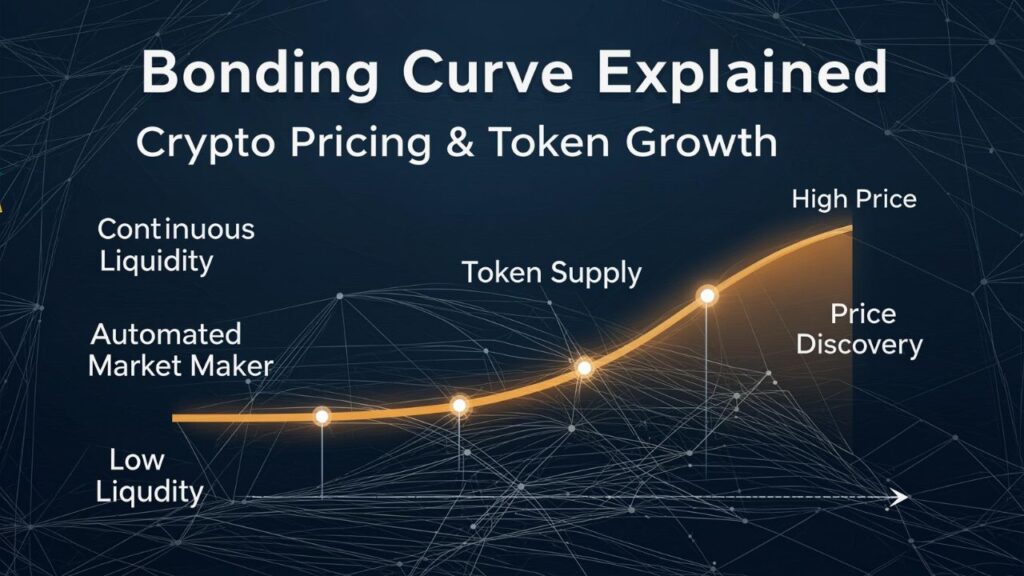
Table of Contents
What Is a Bonding Curve?
How Bonding Curve Models Work
The Mathematics Behind Bonding Curves
Why Bonding Curves Matter in Crypto
Types of Bonding Curve Structures
Real-World Examples of Bonding Curves
Benefits and Risks of Bonding Curves
Bonding Curves in NFTs and DAOs
Personal Background of Key Innovators
Bonding Curve vs Traditional Market Making
Future of Bonding Curve Technology
How Investors Can Use Bonding Curves
FAQ
Conclusion
What Is a Bonding Curve?
A bonding curve is a mathematical pricing mechanism used in blockchain ecosystems to determine the price of a token based on its supply.
In simpler terms, the more people buy a token, the higher the price climbs automatically. Conversely, when users sell tokens back into the system, the price falls according to a predefined formula.
Unlike traditional exchanges where prices depend entirely on market orders, bonding curves use algorithms and smart contracts to create continuous liquidity.
This approach became especially popular in decentralized finance because it removes the need for centralized intermediaries.

Simple Real-World Analogy
Imagine concert tickets that become more expensive every time someone buys one. Early fans get cheaper access, while later buyers pay premium prices because demand increased.
That’s essentially how many bonding curve systems work.
Core Components
Most bonding curve systems rely on:
- Smart contracts
- Token supply formulas
- Automated liquidity
- Reserve assets
- Algorithmic pricing
These elements work together to create self-sustaining token economies.
How Bonding Curve Models Work
Understanding the mechanics behind a bonding curve becomes easier when broken into steps.
Step 1: Token Creation
A project launches a token with a predefined mathematical formula controlling price changes.
Step 2: Early Purchases
When early investors buy tokens, supply increases slightly and the token price rises automatically.
Step 3: Demand Acceleration
As more users enter the market, prices continue climbing according to the curve’s formula.
Step 4: Selling Pressure
When holders sell tokens back to the protocol, supply decreases and prices move downward.
Smart Contracts Handle Everything
The fascinating part is that no human market maker is required.
Smart contracts automatically:
- Calculate pricing
- Process liquidity
- Adjust token supply
- Execute trades
This automation reduces friction and increases transparency.
The Mathematics Behind Bonding Curves
While some formulas become highly advanced, the basic idea remains approachable.
A bonding curve typically connects token supply to token price using mathematical equations.
One common simplified version looks like this:
Where:
- y = token price
- x = token supply
- m = growth rate
- b = starting price
However, many crypto projects use exponential or logarithmic models instead of linear formulas.
Linear Bonding Curves
Prices increase steadily as supply rises.
Advantages include:
- Predictable pricing
- Easier calculations
- Beginner-friendly economics
Exponential Bonding Curves
Prices rise slowly at first, then accelerate dramatically.
These models often create viral speculation because early buyers gain enormous advantages.
Sigmoid Curves
Sigmoid structures attempt to balance sustainability and growth by slowing price increases at higher supply levels.
This approach reduces extreme volatility.
Why Bonding Curves Matter in Crypto
The crypto industry constantly searches for fairer and more efficient ways to distribute tokens.
That’s where bonding curve systems changed the game.
Continuous Liquidity
Traditional token launches sometimes suffer from low liquidity.
Bonding curves solve this by allowing users to buy or sell directly through the protocol at any time.
Fairer Token Distribution
Instead of private insiders controlling supply, prices rise gradually based on participation.
Early supporters benefit, but access remains open.
Reduced Dependence on Exchanges
Projects no longer need massive centralized exchange listings immediately after launch.
That can dramatically lower startup costs.
Community-Driven Growth
Many decentralized communities use bonding curve mechanisms to reward participation and growth organically.
This creates stronger alignment between builders and users.
Types of Bonding Curve Structures
Not all curves behave the same way. Different structures create different economic incentives.
Linear Curves
Linear systems increase price consistently.
| Supply Increase | Price Impact |
|---|---|
| Low | Small increase |
| Medium | Moderate increase |
| High | Predictable increase |
These models are easier for beginners to understand.
Exponential Curves
Exponential curves create aggressive price acceleration.
| Stage | Price Movement |
|---|---|
| Early buyers | Very cheap |
| Mid adoption | Rapid growth |
| Late adoption | Extremely expensive |
Meme coin ecosystems often prefer these models because they generate excitement quickly.
Logarithmic Curves
Prices rise rapidly initially but slow over time.
This helps reduce speculative bubbles.
Sigmoid Curves
Sigmoid structures combine growth with long-term stability.
Many economists consider them more sustainable for larger ecosystems.
Real-World Examples of Bonding Curves
Several blockchain projects successfully implemented bonding curve mechanics.
Friend.tech
Friend.tech introduced social tokens linked to influencer popularity.
As more users purchased access “keys,” prices increased automatically.
This created intense viral momentum.
Pump.fun
The Solana ecosystem saw explosive meme coin growth through Pump.fun.
The platform uses automated pricing mechanisms inspired by bonding curve principles.
Thousands of tokens launch daily using this model.
Bancor Protocol
Bancor pioneered automated liquidity pools long before modern decentralized exchanges became mainstream.
Its innovations heavily influenced DeFi market structures.
NFT Dynamic Pricing
Some NFT projects use bonding curve systems to dynamically adjust mint prices based on demand.
That approach creates fairer market discovery.
Benefits and Risks of Bonding Curves
Like any financial innovation, bonding curves offer powerful advantages alongside serious risks.
Benefits
Instant Liquidity
Users don’t need to wait for counterparties to trade.
Transparent Pricing
Smart contract formulas remain publicly visible on-chain.
Reduced Market Manipulation
Automation can minimize certain centralized trading abuses.
Incentivized Early Participation
Early adopters often receive meaningful rewards.

Risks
Extreme Volatility
Rapid demand spikes can create unsustainable price explosions.
Whale Manipulation
Large investors may still influence price movements significantly.
Smart Contract Vulnerabilities
Coding flaws can create catastrophic losses.
Emotional Trading
Many inexperienced investors panic-buy near the top of exponential curves.
That emotional behavior often leads to heavy losses.
In reality, understanding psychology matters just as much as understanding mathematics.
Bonding Curves in NFTs and DAOs
The influence of bonding curve economics extends far beyond simple token trading.
NFT Pricing Models
Traditional NFTs often rely on fixed pricing.
However, dynamic minting systems using bonding curves can:
- Reward early supporters
- Increase scarcity naturally
- Improve market efficiency
DAO Fundraising
Decentralized Autonomous Organizations (DAOs) increasingly experiment with curve-based treasury systems.
Instead of fixed token allocations, prices evolve according to participation.
Creator Economies
Some platforms allow creators to monetize communities directly through social tokens.
This transforms audiences into active economic participants.
The emotional impact can be surprisingly powerful. Fans feel financially connected to creators they support.
Personal Background of Key Innovators
Simon de la Rouviere
Simon de la Rouviere became one of the earliest voices promoting token bonding curve concepts in blockchain ecosystems.
Career Journey
Originally involved in digital art and decentralized systems, he explored how cryptographic incentives could reshape online communities.
His work influenced many modern DAO and creator economy experiments.
Achievements
Key contributions include:
- Early bonding curve research
- Community token innovation
- NFT economic experiments
- Decentralized governance models
Financial Influence
While exact personal wealth estimates remain unclear, his influence on Web3 economics became substantial as decentralized finance expanded globally.
Many modern token launch systems borrow ideas from his early theoretical work.
Bonding Curve vs Traditional Market Making
To appreciate bonding curve innovation fully, it helps to compare it with traditional finance systems.
| Feature | Traditional Markets | Bonding Curves |
|---|---|---|
| Pricing | Buyer/seller orders | Algorithmic formulas |
| Liquidity | Depends on participants | Continuous |
| Transparency | Partial | Public smart contracts |
| Middlemen | Required | Minimized |
| Speed | Variable | Instant |
Traditional finance still dominates globally, but decentralized systems continue growing rapidly.
That said, automated crypto economics also introduce new risks unfamiliar to traditional investors.
Future of Bonding Curve Technology
The future of bonding curve systems looks increasingly connected to broader Web3 innovation.
AI-Driven Token Economies
Artificial intelligence could eventually optimize dynamic pricing models automatically.
This may improve sustainability and reduce speculative bubbles.
Gaming Economies
Blockchain gaming platforms may use bonding curves for:
- In-game assets
- Character upgrades
- Virtual land pricing
Social Networks
Decentralized social platforms are experimenting with tokenized reputation systems.
Users may eventually buy and sell influence itself.
Institutional Adoption
Larger financial firms continue researching automated liquidity systems inspired by decentralized finance.
Although mainstream adoption remains early, institutional curiosity is growing rapidly.
Regulatory Challenges
Governments worldwide still struggle to regulate decentralized financial systems effectively.
Future legal frameworks may significantly impact how these mechanisms evolve.
How Investors Can Use Bonding Curves
For everyday investors, understanding bonding curve dynamics can improve decision-making dramatically.
Identify Early Opportunities
Early participation often produces the highest upside potential.
However, it also carries the greatest uncertainty.
Avoid Emotional Buying
Many people enter exponential markets too late because of fear of missing out.
Discipline matters enormously.
Study Tokenomics Carefully
Before investing, analyze:
- Supply structure
- Liquidity design
- Smart contract audits
- Team credibility
- Community strength
Watch Volume Trends
Healthy ecosystems usually show sustained organic activity rather than short-term hype spikes.
Diversify Risk
Even promising blockchain systems remain highly speculative.
Experienced investors rarely place all funds into one project.
FAQ
What is a bonding curve in crypto?
A bonding curve is an algorithmic pricing model where token prices automatically change according to supply and demand formulas.
Why are bonding curves important?
They create automated liquidity, transparent pricing, and decentralized token distribution systems.
Are bonding curves risky?
Yes. They can experience extreme volatility, speculative bubbles, and smart contract risks.
How do bonding curves increase token prices?
As more users buy tokens, the mathematical formula raises prices automatically based on supply growth.
What is the difference between AMMs and bonding curves?
Automated Market Makers focus primarily on liquidity pools, while bonding curves directly connect token supply to pricing formulas.
Can NFTs use bonding curves?
Absolutely. Some NFT platforms use dynamic mint pricing based on market demand and participation.
Are bonding curves only used in crypto?
Currently, they are mostly associated with blockchain ecosystems, though similar concepts exist in traditional economics.
Which blockchain projects use bonding curves?
Projects like Friend.tech, Bancor, and Pump.fun use variations of bonding curve mechanics.
Do bonding curves prevent market crashes?
No. They can reduce liquidity problems, but they do not eliminate volatility or investor panic.
Conclusion
The rise of decentralized finance introduced countless innovations, but few are as influential—or misunderstood—as the bonding curve. What appears to be a simple mathematical formula actually reshapes how liquidity, pricing, and community incentives function across blockchain ecosystems.
For investors, creators, and developers, understanding these systems offers a major advantage. It becomes easier to recognize hype, evaluate tokenomics, and make smarter long-term decisions. More importantly, it reveals how crypto markets increasingly rely on automated economic structures rather than traditional intermediaries.
The technology still faces challenges, including volatility, regulation, and sustainability concerns. Yet despite those obstacles, bonding curve models continue influencing NFTs, DAOs, meme coins, creator economies, and decentralized applications at remarkable speed.
As Web3 evolves, these mathematical systems may become as fundamental to digital economies as stock exchanges are to traditional finance today.