
Article
If you searched for bloomify crypto, you are probably trying to figure out whether Bloomify is a DeFi project, a token, a yield platform, or something worth buying. The answer is not as simple as it may look at first, because “Bloomify” appears in crypto-related contexts connected to DeFi yield optimization and token listings such as Bloomify Static and CHARGE.
The important thing to know upfront is that Bloomify is not a mainstream crypto asset like Bitcoin or Ethereum. It appears to be a small, DeFi-related project with limited public market data, which means readers should approach it with extra caution.
This guide explains what bloomify crypto may refer to, how the project has been described publicly, what STATIC and CHARGE mean, how buying may work through a wallet or decentralized exchange, and which risks matter most before making any decision.
Important disclaimer: This article is for general educational purposes only. It is not financial, investment, tax, or legal advice. Crypto assets can be volatile, illiquid, technically complex, and vulnerable to scams or project failure. Always do your own research and consider speaking with a qualified professional before investing.
What Is Bloomify Crypto?
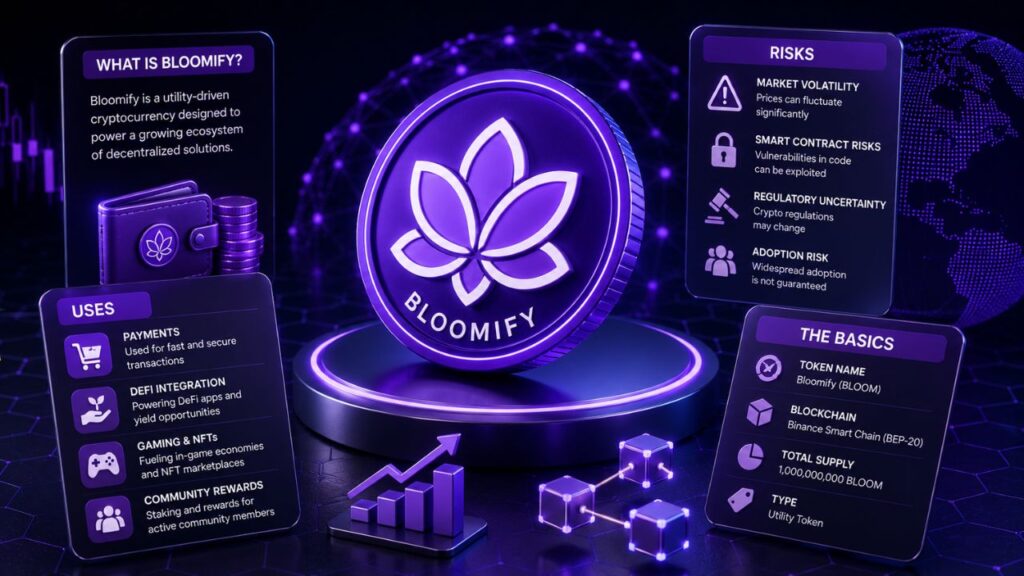
Bloomify crypto generally appears to refer to the Bloomify DeFi ecosystem rather than one single simple coin. Public descriptions have presented Bloomify as a DeFi yield optimizer designed to help users build strategies around staking, liquidity pools, farms, profit-taking, and reinvestment. DappRadar described Bloomify as a platform that allowed users to choose preset strategies focused on accumulating, profit-taking, or more advanced multi-protocol customization.
In practical terms, that means Bloomify sits in the world of decentralized finance, often shortened to DeFi. DeFi platforms usually let users interact with smart contracts instead of traditional banks, brokers, or centralized finance apps. The goal is often to earn yield, swap tokens, provide liquidity, stake assets, or automate parts of a crypto strategy.
However, Bloomify-related assets appear to have thin public market visibility. CoinMarketCap lists Bloomify Static as a preview page with reported total and max supply figures, 0 circulating supply, and a BNB Smart Chain contract reference. Coinbase also notes that Bloomify Static is not tradable on Coinbase and shows limited market data for several metrics.
That does not automatically mean the project is unsafe, but it does mean careful research is essential.
Bloomify, STATIC, and CHARGE: Understanding the Names
One confusing part of bloomify crypto research is that multiple names may appear together. The most common ones are Bloomify, Bloomify Static, STATIC, and CHARGE.
| Term | What it usually refers to | What readers should check |
|---|---|---|
| Bloomify | The broader DeFi/yield optimizer brand or ecosystem | Official website, docs, team updates, product status |
| Bloomify Static | A token listed under the ticker STATIC | Contract address, liquidity, supply, tradability |
| STATIC token | The token associated with Bloomify Static | Rebase mechanics, use case, market data |
| CHARGE token | Another Bloomify-related token listing | Tokenomics, supply, utility, active markets |
| DeFi yield optimizer | A platform that may automate staking, farming, or reinvestment | Smart contract risk, fees, performance history |
Coinbase describes Bloomify Static as an algorithmic stablecoin ecosystem with rebase mechanics, where supply mechanics are connected to whether the value is above or below a target level. CoinMarketCap also lists a separate Bloomify page under the ticker CHARGE, with preview-style token data and self-reported circulating supply information.
For beginners, the key point is this: do not assume every Bloomify-related token is the same asset. STATIC and CHARGE may have different roles, different contract addresses, different liquidity, and different risk profiles.
How Bloomify Fits Into DeFi
To understand bloomify crypto, it helps to understand the DeFi category it belongs to.
A DeFi yield optimizer is typically built to help users manage yield-generating strategies. Instead of manually moving funds between farms, pools, and staking contracts, users may be able to choose a strategy that handles some of that work automatically.
Bloomify has been described as allowing users to select multi-layer strategies involving liquidity pools, farms, profit-taking, and reinvestment. In plain English, that means a user might deposit crypto into a strategy that tries to generate yield and then either reinvests rewards, takes profits, or balances between different DeFi actions.
Why Yield Optimization Appeals to Crypto Users
The appeal is easy to understand. DeFi can be complicated. A user may need to understand:
- Which tokens to pair in a liquidity pool
- How farm rewards are paid
- Whether rewards should be sold or compounded
- How gas fees affect returns
- Whether a smart contract has been audited
- How much liquidity exists when entering or exiting
A platform that simplifies these choices can be attractive, especially for users who want exposure to DeFi without managing every action manually.
But simplification does not remove risk. In fact, automation can sometimes make risk harder to see.
The Role of Algorithmic Stablecoin and Rebase Mechanics
One notable detail around Bloomify Static is the reference to an algorithmic stablecoin ecosystem and rebase mechanics. In crypto, a rebase token changes supply according to preset rules. In many models, the system expands or contracts token supply in response to price targets.
This can sound clever, but it is also complex. Rebase systems can create confusing balances, unexpected dilution, thin liquidity, and sharp price movements. If demand falls or liquidity dries up, the mechanism may not protect holders in the way beginners expect.
That is why any token involving algorithmic stablecoin language deserves extra scrutiny.
Is Bloomify Crypto Legit?
A better question is: “Can I verify enough about Bloomify to feel comfortable with the risk?”
For smaller DeFi projects, legitimacy is not always black and white. A project may have public token pages, an old blog presence, a working contract, and some historical activity, but still have limited current traction, low liquidity, incomplete market data, or reduced development activity.
For bloomify crypto, several public signals suggest caution:
- Some available articles and community updates are from 2022.
- Public market pages may show limited, preview, or incomplete data.
- Coinbase states that Bloomify Static is not tradable on Coinbase.
- Binance’s guide says Bloomify Static is not available through the centralized Binance exchange and would require a Web3 Wallet and DEX route.
- Thin market data can make pricing, liquidity, and exit planning harder to evaluate.
None of these points alone proves that the project is bad. But together, they show why a reader should avoid rushing into a purchase based only on a token page, social post, or “how to buy” guide.
Who Might Be Interested in Bloomify Crypto?
Bloomify crypto may interest a narrow group of crypto users who already understand DeFi mechanics and are comfortable researching smaller tokens.
It may be relevant for:
- Experienced DeFi users studying older yield optimizer projects
- Crypto researchers comparing small-cap DeFi ecosystems
- Users investigating Bloomify Static or CHARGE contract data
- People learning how rebase tokens and algorithmic models work
- Traders who understand DEX liquidity, slippage, and smart contract risk
It is less suitable for someone who is brand new to crypto, wants a simple long-term investment, or does not understand how wallets, DEXs, gas fees, and contract addresses work.
Who Should Be Extra Careful or Avoid It?
A small, lightly tracked DeFi asset may not be appropriate for everyone.
You should be especially careful if:
- You are buying because someone promised easy profits.
- You cannot explain what STATIC or CHARGE does.
- You have not verified the token contract address.
- You do not understand slippage or liquidity.
- You are using borrowed money.
- You cannot afford to lose the full amount.
- You are relying only on social media hype.
- You assume “stablecoin” means risk-free.
The word “stablecoin” can be misleading when used in algorithmic or experimental DeFi systems. Some algorithmic stablecoin projects in the wider crypto market have failed dramatically in the past, so the label should never be treated as a guarantee of safety.
Potential Benefits of Bloomify Crypto
A fair article should not only focus on risk. There are reasons why people may look into bloomify crypto.
Strategy Flexibility
Bloomify has been described as offering different DeFi strategies, including accumulation, profit-taking, and advanced customization. For users who understand yield farming, this kind of flexibility can be useful.
DeFi Automation
Manually managing DeFi positions can be time-consuming. Users may need to claim rewards, reinvest, rebalance, and monitor fees. A yield optimizer aims to reduce some of that manual work.
Learning Value
Even if someone never buys the token, studying Bloomify can help them understand bigger DeFi ideas such as:
- Liquidity pools
- Farm rewards
- Reinvestment strategies
- Token supply mechanics
- Rebase tokens
- DEX trading
- Smart contract risk
Early-Stage Opportunity
Some investors are drawn to small projects because they believe early discovery can create upside. But this is also where risk is highest. Low liquidity, limited data, inactive communities, and unclear development can make small tokens extremely unpredictable.
Major Risks to Understand Before Buying
The risks around bloomify crypto are not minor details. They are central to the decision.
1. Limited Market Data
When a token has incomplete or thin data, it is harder to answer basic questions:
- What is the real circulating supply?
- How much trading volume exists?
- Are there active buyers and sellers?
- Can you exit without major slippage?
- Is the displayed price reliable?
CoinMarketCap’s Bloomify Static page shows preview-style information, including reported supply details and 0 circulating supply. That kind of data should make investors slow down and verify from multiple sources.
2. Liquidity Risk
Liquidity means how easily you can buy or sell without moving the price too much. A token may show a price, but if there is little liquidity, selling a meaningful amount can become difficult.
Low liquidity can cause:
- Large price impact
- Failed swaps
- High slippage
- Wide gaps between displayed and actual execution price
- Difficulty exiting during market stress
3. Smart Contract Risk
DeFi platforms run on code. If the code has a vulnerability, users may lose funds. Even audited contracts are not risk-free.
Smart contract risk includes:
- Bugs
- Exploits
- Oracle issues
- Admin-key risk
- Upgrade risk
- Poorly designed token mechanics
- Vulnerable third-party integrations
4. Rebase and Algorithmic Risk
If STATIC token mechanics involve rebasing, holders need to understand how supply changes affect balances and value. A larger token balance does not automatically mean greater wealth if each token is worth less.
Algorithmic systems can also break down when market demand changes.
5. Project Activity Risk
A DeFi project can have old documentation and token listings but limited current development. Before engaging with Bloomify, check whether the team, community, docs, social channels, and contracts appear active.
6. Exchange and Wallet Risk
Binance’s guide indicates that buying Bloomify Static involves using a Web3 wallet and a decentralized exchange, not the centralized Binance exchange. That means users may face wallet security risks, DEX slippage, gas fees, and contract-address scams.
7. Scam and Impersonation Risk
Small-cap crypto projects are often copied by scammers. Fake tokens can use similar names, tickers, logos, or websites. Always verify contract addresses from multiple trusted sources before swapping.
How to Research Bloomify Crypto Before Buying
Before considering any purchase, use a structured research process.
Step 1: Confirm Which Asset You Mean
Start by identifying whether you are researching:
- Bloomify as a DeFi platform
- Bloomify Static
- STATIC
- CHARGE
- Another token using a similar name
Do not search the name alone and assume the first result is correct.
Step 2: Verify the Contract Address
For DEX-traded tokens, the contract address matters more than the name. Token names can be copied. Contract addresses are harder to fake if you verify them from reputable sources.
Check:
- CoinMarketCap or Coinbase asset pages
- Official project documentation
- Blockchain explorers such as BscScan or FTMScan
- Reputable wallet or DEX token lists
Coinbase lists Bloomify Static network details including BNB Smart Chain and Fantom contract references. Always compare addresses carefully before interacting with a token.
Step 3: Check Liquidity
Before swapping, look at the actual liquidity pool. Ask:
- How much liquidity is available?
- Which token is it paired with?
- Is liquidity locked?
- Are trades happening regularly?
- Would your buy or sell create high slippage?
If liquidity is extremely thin, even a small trade can become risky.
Step 4: Read the Documentation
Look for clear documentation explaining:
- What the project does
- How the token is used
- How fees work
- How rewards are generated
- Whether contracts are audited
- Who controls admin functions
- What risks are disclosed
If documentation is vague, outdated, missing, or overly promotional, treat that as a warning sign.
Step 5: Review Community and Development Activity
A living project usually has recent updates. Check whether official channels show meaningful activity, not just recycled marketing posts.
Look for:
- Development updates
- Governance activity
- Product releases
- Security announcements
- Community support
- Transparent responses to user questions
Older updates can still be useful for history, but they should not be treated as proof of current health.
Step 6: Understand the Tokenomics
For bloomify crypto, tokenomics research should include:
- Total supply
- Circulating supply
- Max supply
- Emission schedule
- Rebase rules
- Rewards source
- Treasury controls
- Staking incentives
- Unlocks or team allocation
- Burn or mint mechanics
If you cannot understand how value flows through the system, do not buy.
Step 7: Start With Risk, Not Reward
Many beginners start by asking, “How much can this go up?” A better first question is, “How can I lose money here?”
Possible loss paths include:
- Token price collapse
- Low liquidity
- Contract exploit
- Failed rebase model
- Scam token purchase
- Wallet compromise
- High fees
- Inability to sell
How Buying Bloomify Static Typically Works
This section is educational, not a recommendation.
Because Bloomify Static is not listed on some centralized exchanges, buying may require a Web3 wallet and a DEX. Binance’s own guide says users cannot purchase Bloomify Static directly on the Binance centralized exchange and would need to use the Binance Web3 Wallet and a decentralized exchange route.
A typical process may look like this:
- Set up a compatible crypto wallet.
- Fund the wallet with a supported token such as USDT, BNB, or another trading pair asset.
- Find the correct token contract address.
- Connect to a reputable decentralized exchange.
- Review liquidity, price impact, and slippage.
- Enter a small test amount.
- Confirm the transaction.
- Store the token securely.
- Track the position and exit conditions.
The most important step is contract verification. Never buy a token only because the name looks right.
Cost and Budget Considerations
Buying small DeFi tokens involves more than the listed token price.
You may need to account for:
- Network gas fees
- Wallet funding fees
- DEX swap fees
- Slippage
- Price impact
- Bridge fees if moving assets across chains
- Tax reporting costs
- Potential losses from failed transactions
For US readers, crypto transactions may have tax implications. Selling, swapping, earning rewards, staking, or receiving yield can potentially create taxable events depending on your situation. Keep records and consider speaking with a qualified tax professional.
A practical rule for speculative small-cap tokens is simple: only use money you can afford to lose completely.
Common Mistakes to Avoid
Mistake 1: Assuming “Listed” Means “Safe”
A token page on a tracking site does not guarantee quality, liquidity, or legitimacy. Some pages rely on third-party data, self-reported data, or limited market feeds.
Mistake 2: Ignoring Contract Addresses
Fake tokens often use real project names. Always verify the contract address.
Mistake 3: Confusing STATIC and CHARGE
STATIC and CHARGE are not interchangeable terms. They may represent different assets in the Bloomify ecosystem.
Mistake 4: Believing “Stablecoin” Means Stable
An algorithmic stablecoin or rebase token can behave very differently from a fully reserved, widely used stablecoin. Stability depends on design, demand, liquidity, and market confidence.
Mistake 5: Overlooking Exit Liquidity
Buying is often easier than selling. Before entering, estimate how easily you could exit.
Mistake 6: Chasing Yield Without Understanding Source
High yield is not magic. It comes from somewhere: emissions, trading fees, incentives, leverage, risk transfer, or new buyers. If you cannot identify the source, be cautious.
Bloomify Crypto Compared With Larger DeFi Options
Here is a practical comparison for readers deciding whether to explore Bloomify or stick with more established DeFi platforms.
| Factor | Bloomify crypto | Larger DeFi protocols |
|---|---|---|
| Public data | May be limited or incomplete | Usually broader market coverage |
| Liquidity | May be thin | Often deeper, but varies |
| Risk level | Potentially high | Still risky, but often easier to research |
| Beginner suitability | Low | Medium, depending on protocol |
| Token complexity | Can involve rebase or ecosystem mechanics | Varies by project |
| Exchange access | May require Web3 wallet and DEX | Some assets may be on major exchanges |
| Research burden | High | Moderate to high |
A beginner may be better served learning with established assets and small amounts before touching thinly traded DeFi tokens.
A Practical Decision Framework
Before engaging with bloomify crypto, answer these questions honestly:
- Do I know exactly which token I am buying?
- Have I verified the contract address from multiple sources?
- Do I understand the difference between Bloomify Static, STATIC, and CHARGE?
- Can I explain the token’s purpose in one sentence?
- Is there enough liquidity for me to exit?
- Are project updates recent and meaningful?
- Do I understand the rebase or algorithmic mechanics?
- Have I checked smart contract and admin risks?
- Am I comfortable losing the full amount?
- Have I considered taxes and recordkeeping?
If you cannot answer most of these, pause before buying.
Safer Alternatives to Consider
If your real goal is learning DeFi, you do not have to start with a small token.
You could instead explore:
- Major crypto education resources
- Blue-chip DeFi protocols with larger communities
- Stablecoin risk education
- Wallet safety practice with tiny amounts
- DEX tutorials using well-known tokens
- Paper tracking a token before buying
- Reading smart contract audit basics
If your goal is yield, compare the risk-adjusted return. A lower yield from a more transparent platform may be more suitable than a high-risk token with unclear liquidity.
Beginner Tips for Researching Small DeFi Tokens
A cautious beginner can use these habits:
- Bookmark official sources instead of clicking random links.
- Use a separate wallet for experimental DeFi.
- Never store large amounts in a hot wallet.
- Test with a small transaction first.
- Keep screenshots and transaction records.
- Do not approve unlimited token spending unless necessary.
- Revoke unused token approvals when possible.
- Ignore direct messages offering help or private deals.
- Avoid buying under pressure.
- Read negative opinions, not just promotional posts.
Good crypto research is slow and skeptical.
FAQ
What is Bloomify crypto?
Bloomify crypto usually refers to the Bloomify DeFi ecosystem and related tokens such as Bloomify Static, STATIC, and CHARGE. Public descriptions connect Bloomify with DeFi yield optimization and strategy automation.
Is Bloomify Static the same as Bloomify?
Not exactly. Bloomify may refer to the broader ecosystem or platform, while Bloomify Static refers to the STATIC token. There is also a CHARGE token listing associated with Bloomify-related pages.
Can I buy Bloomify crypto on Coinbase?
Coinbase states that Bloomify Static is not tradable on Coinbase, although it provides informational price and asset data.
Can I buy Bloomify Static on Binance?
Binance’s guide says Bloomify Static is not available directly on the centralized Binance exchange. It describes a Web3 Wallet and DEX route instead.
Is Bloomify crypto safe?
No small DeFi token should be assumed safe. Risks may include low liquidity, smart contract vulnerabilities, rebase mechanics, thin market data, wallet mistakes, and project inactivity.
What is STATIC in Bloomify?
STATIC is the ticker commonly associated with Bloomify Static. It has been described as part of an algorithmic stablecoin ecosystem with rebase mechanics.
What is CHARGE?
CHARGE appears as another Bloomify-related token ticker on public tracking pages. CoinMarketCap lists a Bloomify page under CHARGE with preview-style data.
Should beginners invest in Bloomify crypto?
Beginners should be very cautious. If you do not understand wallets, DEXs, liquidity, contract addresses, slippage, and rebase tokens, it is better to learn those basics first.
Conclusion
Bloomify crypto is best understood as a DeFi-related topic that requires careful research, not as a simple buy-or-skip asset. Bloomify has been publicly described as a yield optimizer, while related tokens such as Bloomify Static, STATIC, and CHARGE appear in crypto tracking and buying-guide contexts.
The biggest takeaway is caution. Limited market data, DEX-based access, rebase mechanics, liquidity concerns, and project-activity questions all make due diligence essential. For experienced DeFi users, Bloomify may be worth studying as part of the broader yield-optimization landscape. For beginners, it is a reminder that not every crypto asset with a token page is easy to understand, easy to trade, or suitable to buy.
A smart next step is not rushing into a swap. It is verifying the asset, reading the documentation, checking liquidity, understanding the token mechanics, and deciding whether the risk truly fits your situation.