Introduction
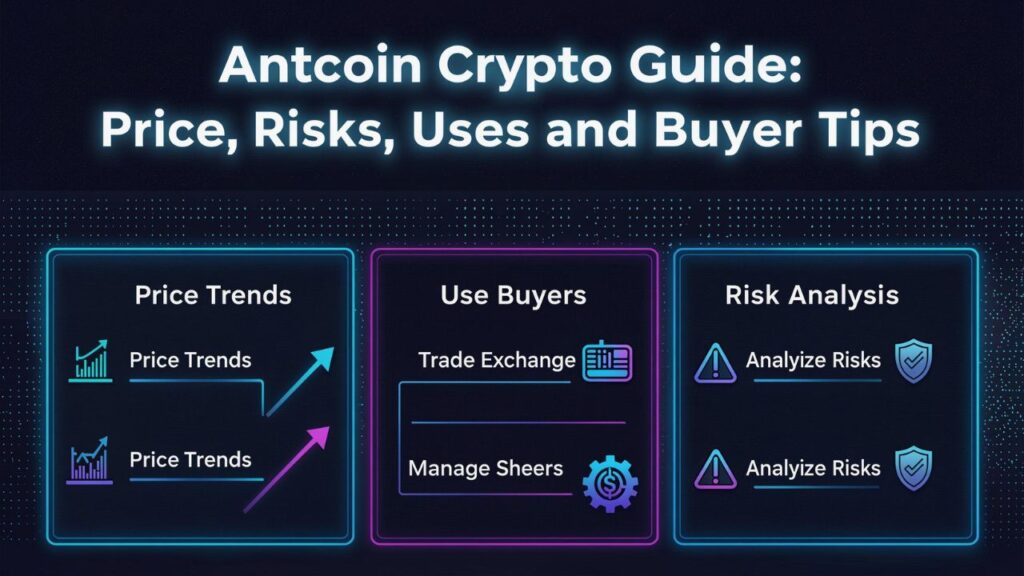
Crypto names can be confusing, and few prove that better than antcoin. One person may use the term for a small token, another may mean an ANT ticker, and someone else may be referring to a completely different blockchain project.
That confusion matters because sending money to the wrong contract, trusting the wrong chart, or buying a token based only on a name can be risky. Current public listings show several similarly named or similarly tickered assets, including ANTSCOIN on CoinMarketCap, AntCoin pages on market trackers, Aragon’s ANT token, and Autonomi’s ANT token, so research should start with the exact contract, chain, and official source.
This guide explains what the term can mean, how to research it, what risks to check, and how to avoid the common mistakes people make with small or confusing crypto assets.
Table of Contents
- What Is antcoin?
- Why the Name Can Be Confusing
- How antcoin Works in Simple Words
- Tokenomics and Supply Details
- Price, Market Data, and Liquidity Checks
- Use Cases and Project Claims
- How to Research antcoin Before Buying
- Risks, Red Flags, and Safety Checks
- Wallets, Exchanges, and Contract Verification
- Project Background and Financial Insights
- FAQs
- Conclusion
What Is antcoin?
antcoin is best understood as a crypto-related search term that may refer to more than one token or project. That is the first thing buyers should understand before looking at price, charts, or community posts.
Some search results point to an Ant Network project using the name ANTCOIN and a token supply shown as 100,000,000 ANTc on its website. The site presents ideas around mobile mining, an advertising network, and a social network.
Other trackers show different assets with similar names. CoinCarp describes an AntCoin token on Binance Smart Chain with a 6% transaction tax, split between community redistribution and liquidity.
CoinMarketCap also lists ANTSCOIN under the ticker ANTS, with a max supply of 1,000,000,000 ANTS and no reported circulating supply in the search result snippet.
This is why the safest answer is simple: do not judge antcoin by name alone. Always identify the exact project, chain, ticker, contract address, official website, white paper, and exchange listing before making any decision.
Why the Name Can Be Confusing
Crypto tickers are not always unique. Different tokens can use similar names, similar branding, or even the same ticker on different chains. That creates confusion for new buyers.
For example, ANT is also associated with Aragon, a better-known historical crypto project. CoinMarketCap currently lists Aragon under ANT with a live market cap and circulating supply data.
Autonomi also appears under the ANT ticker on CoinMarketCap, with its own price, supply, and market capitalization data.
That means a person searching for antcoin may accidentally land on Aragon, Autonomi, ANTSCOIN, AntCoin on BSC, or another similarly named project. This is not a small detail. Buying the wrong token can mean holding a completely different asset than intended.
Common Confusion Points
| Confusion Point | Why It Matters |
|---|---|
| Similar token names | Different projects may sound almost the same |
| Similar tickers | ANT, ANTS, ANTc, and other variants can appear |
| Different blockchains | A token may exist on BSC, Avalanche, Ethereum, or another chain |
| Unverified contracts | Fake tokens can copy names and logos |
| Thin liquidity | A chart may show a price but have little real trading activity |
| Old listings | Some pages may exist even when a project is inactive |
How antcoin Works in Simple Words
To understand antcoin, start with the basic crypto model. A token is a digital asset created on a blockchain. It may be used for payments, rewards, access, governance, staking, gaming, advertising, community incentives, or nothing meaningful at all.
A serious token usually has:
- A clear contract address
- A public blockchain explorer page
- A white paper or documentation
- Transparent supply information
- Clear token utility
- Real liquidity
- Active development
- Public team or verifiable organization
- Security checks or audits
- Realistic roadmap
For any antcoin-related asset, the goal is to confirm whether these basics exist. If they do not, the risk becomes much higher.
Token vs Coin
Many people call every crypto asset a “coin,” but there is a difference. A coin usually belongs to its own blockchain, like Bitcoin or Ethereum. A token is usually created on an existing blockchain, like Ethereum, BNB Smart Chain, Avalanche, or Polygon.
Some AntCoin references describe a token rather than a native coin. CoinCarp, for instance, describes AntCoin as a token on Binance Smart Chain.
Tokenomics and Supply Details
Tokenomics means how a crypto asset is structured economically. It includes supply, distribution, taxes, burns, rewards, vesting, liquidity, and incentives.
For antcoin research, tokenomics should be checked carefully because smaller tokens often depend heavily on supply structure and liquidity.
Important Tokenomics Questions
| Question | Why It Matters |
|---|---|
| What is the total supply? | Helps estimate scarcity and dilution risk |
| What is the circulating supply? | Shows how many tokens may actually trade |
| Is there a max supply? | Helps understand future inflation |
| Are there buy or sell taxes? | Taxes affect every trade |
| Who owns large wallets? | Whale concentration can affect price |
| Is liquidity locked? | Unlocked liquidity can be risky |
| Are tokens vested? | Unlocks can create selling pressure |
| Is the contract renounced or controlled? | Admin powers can affect holders |
| The Ant Network website displays a total supply of 100,000,000 ANTc, while CoinMarketCap’s ANTSCOIN listing shows a max supply of 1,000,000,000 ANTS. These are different figures tied to different listings, which again shows why exact project identification is necessary. |
Price, Market Data, and Liquidity Checks
Price alone does not tell the full story. A token can show a price online and still have almost no real market depth.
For example, CoinMarketCap’s ANTSCOIN result shows a live price and a 24-hour trading volume of $0 or unavailable in the snippet. That type of low or missing volume should make buyers cautious because it may be difficult to enter or exit a position smoothly.
Bitget’s ANTCOIN page shows a very small market cap in the search result snippet. Very small market caps can move sharply in both directions and may be vulnerable to low-liquidity swings.
What to Check Before Trusting a Price
- 24-hour trading volume
- Liquidity pool size
- Number of holders
- Exchange quality
- Buy and sell spread
- Recent transaction history
- Contract address
- Whether trading is active
- Whether selling is possible
- Whether price differs across trackers
A real-life example helps. Imagine a token chart shows a price increase of 80%, but only a few dollars traded that day. That does not mean buyers can sell a large amount at that price. It may only mean one tiny trade moved the chart.
Use Cases and Project Claims
Every crypto project should explain why its token exists. A token without a clear use case may depend only on hype.
The Ant Network website mentions an advertising network and a social network as project areas, with language about bringing advertising industry volume into crypto and creating a social network that does not manipulate user data.
These claims should be researched further. A website claim is only the starting point. Buyers should look for working products, users, partnerships, public code, audited contracts, transparent updates, and real adoption.
Stronger Use Case Signals
| Signal | What It Suggests |
|---|---|
| Working product | The project is beyond only an idea |
| Active users | People actually use the ecosystem |
| Public roadmap updates | Development is continuing |
| Clear token role | The token has a reason to exist |
| Real revenue model | The project may have business logic |
| Open documentation | Users can verify details |
| Independent listings | The asset is visible beyond its own site |
| Security audit | Smart contract risk may be reduced |
Weak Use Case Signals
- Vague promises
- No product screenshots
- No public team
- No documentation
- No code repository
- No liquidity information
- No clear reason for the token
- Overuse of buzzwords
- Guaranteed profit language
How to Research antcoin Before Buying
Good crypto research is slow and slightly boring. That is a good thing. Boring research protects people from emotional mistakes.
Start by confirming the exact token. Do not begin with price predictions or social media comments. Begin with identity.
Step 1: Confirm the Official Website
Find the official website from a trusted listing, not from a random Telegram message or ad. Check whether the domain looks legitimate and whether it links to official social channels.
Step 2: Confirm the Contract Address
Copy the contract address from the official source and compare it with the exchange or DEX page. One wrong character can mean a different token.
Step 3: Check the Chain
Is it on Binance Smart Chain, Avalanche, Ethereum, or another network? The chain affects fees, wallets, liquidity, and explorer tools.
Step 4: Read the White Paper
A white paper should explain the project, token role, roadmap, supply, risks, and technical design. If it only contains vague marketing language, be careful.
Step 5: Check Liquidity and Volume
A token with low liquidity can be hard to sell. Price charts can look exciting but still be misleading.
Step 6: Check Holder Distribution
If a few wallets hold most of the supply, price risk may be higher.
Step 7: Look for Independent Mentions
Search for third-party coverage, exchange listings, audits, developer activity, and community discussion.
![Infographic suggestion: “Crypto Token Safety Checklist” with icons for official website, contract address, chain, liquidity, audit, holders, volume, roadmap, and risk warning]
Risks, Red Flags, and Safety Checks
Crypto is already volatile. Small or unclear tokens can be even riskier.
The biggest risk with antcoin is name confusion. The second major risk is low liquidity. The third is incomplete information.
Red Flags to Watch
- No clear contract address
- Several fake-looking token pages
- Very low trading volume
- No working product
- Anonymous team with no accountability
- No audit
- Unclear tokenomics
- High buy or sell tax
- Liquidity not locked
- No active community except hype messages
- Guaranteed return claims
- Pressure to buy quickly
- Admin wallet has strong control
Security Checks
Use a blockchain explorer to review transactions, holders, contract verification, and liquidity pool behavior. If you cannot understand those details, ask someone technical before buying.
Also, never connect your main wallet to unknown websites. Use a separate wallet for high-risk tokens. Keep only small test funds there. This reduces damage if a malicious site asks for unsafe permissions.
Wallets, Exchanges, and Contract Verification
Where you can buy antcoin depends on which exact token you mean. Some similarly named assets appear on trackers, while others may trade only through decentralized exchanges or small platforms.
For any small token, the safest workflow is:
- Identify the official contract.
- Confirm the blockchain.
- Check the token on a trusted explorer.
- Check liquidity on the DEX.
- Review holder concentration.
- Make a tiny test transaction first.
- Confirm you can sell before buying more.
- Avoid links from random social posts.
Centralized vs Decentralized Exchanges
| Exchange Type | Benefit | Risk |
|---|---|---|
| Centralized exchange | Easier for beginners | Listing does not remove all risk |
| Decentralized exchange | Direct wallet trading | Higher scam-token and contract risk |
| Market tracker | Useful for data | May show inactive or low-liquidity tokens |
| Project website | Official starting point | Must still be verified independently |
| A token being listed somewhere does not automatically make it safe. Trackers can show many assets, including very small, inactive, or low-liquidity projects. |
antcoin and Price Predictions
People often search for price predictions after finding a token. That is understandable, but it can be dangerous.
Small crypto assets are affected by liquidity, listings, community hype, token unlocks, whale wallets, broader market sentiment, and development activity. A prediction model cannot reliably account for all of that.
Any antcoin prediction should be treated as speculation. Instead of asking “how high can it go,” a better question is “what would need to happen for this token to become more useful, liquid, trusted, and widely traded?”
Smarter Questions Than Price Prediction
- Is the project still active?
- Is liquidity growing?
- Are real users joining?
- Is the token needed in the ecosystem?
- Is the team communicating clearly?
- Are there exchange listings with real volume?
- Are smart contracts verified?
- Are large wallets selling or accumulating?
This kind of thinking is less exciting than price hype, but it is much safer.
Project Background and Financial Insights
This topic is about a crypto term and possible token projects, not a public individual, so personal background and net worth are not directly applicable.
However, project background is still important. The Ant Network site presents ANTCOIN as part of a broader ecosystem idea involving mobile mining, advertising, and social networking.
Other listings point to separate assets, such as AntCoin on Binance Smart Chain, ANTSCOIN, Aragon ANT, and Autonomi ANT. These should not be treated as the same project unless official documentation proves a connection.
Financially, small crypto tokens can be extremely fragile. A low market cap may create dramatic upside stories, but it can also mean poor liquidity, higher volatility, thin order books, and difficulty selling. That is why risk control matters more than excitement.
How antcoin Compares With Larger Crypto Assets
Larger crypto assets usually have more data, deeper liquidity, more exchange coverage, more wallets, and more public analysis. Smaller tokens often have less information and higher uncertainty.
| Factor | Larger Crypto Assets | Small or Unclear Tokens |
|---|---|---|
| Liquidity | Usually deeper | Often thin |
| Exchange access | Often broader | May be limited |
| Information quality | More public research | Often fragmented |
| Volatility | Still high | Often much higher |
| Scam-copy risk | Present but lower | Can be higher |
| Community size | Larger | Smaller or hype-driven |
| Exit ability | Usually easier | Can be difficult |
| That does not mean every small token is bad. It means research needs to be stricter. |
Common Mistakes Beginners Make
Buying the Wrong Token
This is the most common risk with similar names. Always verify the contract.
Trusting Screenshots
Screenshots of profit, price charts, or exchange balances can be fake or misleading.
Ignoring Liquidity
A token may show a price but have almost no buyers.
Skipping the White Paper
If the project cannot explain itself clearly, that is a problem.
Using a Main Wallet
Never risk your main wallet on unknown dApps or token sites.
Following Hype Groups
Telegram, X, Discord, and YouTube can spread useful information, but they can also amplify emotional buying.
Forgetting Taxes and Fees
Transaction taxes, gas fees, and spreads can reduce returns.
FAQs
What is antcoin?
antcoin is a crypto-related term that may refer to different projects or tokens. Because similar names and tickers exist, users should verify the exact contract, chain, and official source before doing anything.
Is antcoin the same as Aragon ANT?
Not necessarily. Aragon uses the ANT ticker, but that does not mean every antcoin reference is Aragon. CoinMarketCap lists Aragon as ANT, while other AntCoin or ANTSCOIN listings also exist separately.
Is antcoin safe to buy?
No crypto token can be called fully safe. Smaller or unclear tokens require extra caution because of low liquidity, fake contracts, limited information, and high volatility.
How do I find the real antcoin contract address?
Start from the official website or a reputable listing, then compare the contract address on a blockchain explorer and the exchange page. Never copy a contract from a random comment or direct message.
Why are there different ANT coins?
Crypto tickers are not always unique across all platforms. Different projects can use similar symbols, names, or branding, which creates confusion for buyers.
Can antcoin reach a high price?
No one can reliably predict that. Price depends on liquidity, demand, exchange access, tokenomics, adoption, market cycles, and holder behavior.
What should I check before buying antcoin?
Check the official website, contract address, blockchain, liquidity, trading volume, holder distribution, audit status, white paper, roadmap, and whether selling is possible.
Is low trading volume a bad sign?
It can be. Low volume may mean poor market interest and difficulty selling. CoinMarketCap’s ANTSCOIN snippet, for example, shows unavailable or zero 24-hour volume, which should make buyers cautious.
Should beginners buy small tokens like antcoin?
Beginners should be careful with small or confusing tokens. It is better to learn wallet safety, contract verification, liquidity checks, and risk management first.
Is this financial advice?
No. This article is educational only. Crypto decisions should be based on personal research, risk tolerance, and, when needed, advice from a qualified financial professional.
Conclusion
antcoin is not a term to treat casually. It can point to different assets, similar tickers, and separate projects. That makes verification more important than hype.
Before buying, confirm the exact contract, chain, liquidity, supply, project website, white paper, and trading activity. Check whether the project has real use, real volume, and clear communication.
Crypto rewards curiosity, but it punishes rushing. Take the slower path. Research first, protect your wallet, question big claims, and never let a familiar-sounding name replace real due diligence.