

Most people don’t realize that sitting on ethereum is costing them money. Not through losses — through missed opportunity. Since Ethereum’s historic shift to Proof of Stake in September 2022, known as “The Merge,” regular holders have been earning consistent ethereum staking rewards simply by locking up their ETH and helping secure the network. No trading skills required. No complex algorithms. Just holding, contributing, and earning.
The idea sounds almost too simple, and that skepticism makes sense. Crypto is still an industry where confusion and misinformation spread faster than genuine education. But ethereum staking is a real, well-documented mechanism backed by the Ethereum protocol itself — not a gimmick or a yield-farming scheme. Millions of ETH are already staked by individuals worldwide, and that number continues to grow.
If you’ve been curious about eth staking but unsure where to begin, this guide is written for you. We’ll break down exactly how it works, how much you can realistically earn, what your options are as a regular person (not a tech expert), and what risks you should understand before committing a single dollar.
What Is Ethereum Staking and Why Does It Matter?
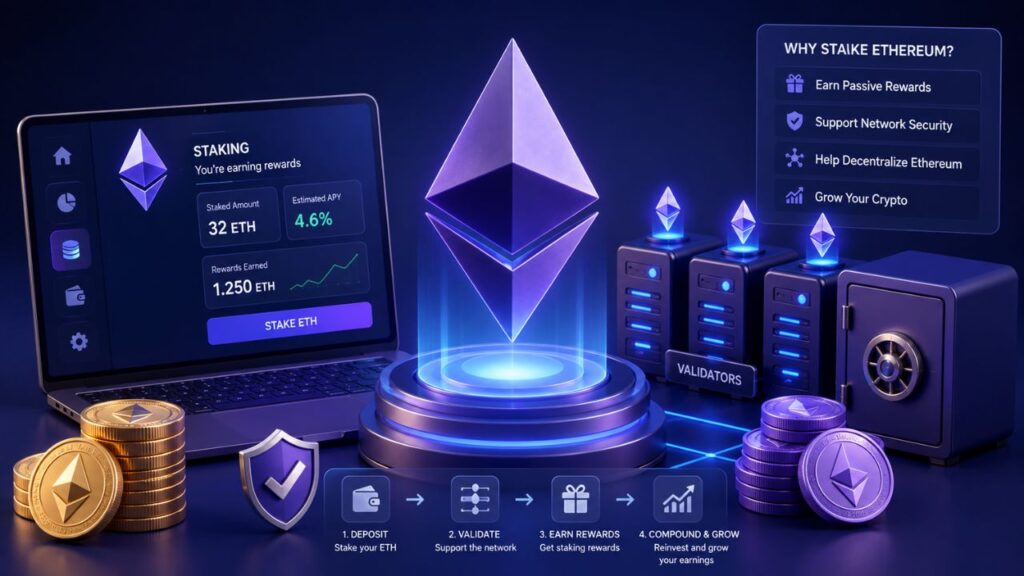
At its core, ethereum staking means locking up a certain amount of ETH to help validate transactions on the Ethereum blockchain. In exchange for this service, you earn ethereum staking rewards — a share of newly issued ETH plus transaction fees.
Before The Merge, Ethereum ran on Proof of Work, the same energy-intensive system Bitcoin still uses. Miners competed to solve complex mathematical puzzles, consuming massive amounts of electricity. Proof of Stake replaced that entirely. Instead of energy, the network now relies on validators who put up ETH as collateral — their “stake” — and are chosen to confirm blocks of transactions. If they behave honestly, they earn rewards. If they try to cheat the system, they risk losing a portion of their stake through a penalty called “slashing.”
This design accomplishes two things simultaneously: it secures the network and distributes newly generated ETH to participants. For everyday holders, that means an opportunity to earn crypto passively, without selling or trading anything.
How Ethereum Staking Rewards Are Calculated
The question everyone asks first is: how much can I actually earn? The honest answer is — it depends, but there’s a clear framework.
Ethereum staking rewards are not fixed like a savings account interest rate. They’re variable, calculated based on the total amount of ETH currently staked across the entire network. The more ETH that’s staked globally, the lower the individual reward rate becomes, and vice versa. This is by design — the protocol adjusts dynamically to maintain network security without overpaying.
Typical Annual Percentage Rates
Historically, eth staking rewards have ranged between roughly 3% and 6% annually, denominated in ETH. At times of lower total stake participation, yields have pushed toward the higher end. As of recent network data, the annualized reward rate has generally hovered around 3.5% to 4.5%.
Here’s what matters: you earn rewards in ETH, not in dollars. So if ETH price increases while you’re staking, your dollar-equivalent returns grow significantly. If prices drop, the opposite is true. The staking mechanism itself doesn’t protect you from market price volatility — that’s a separate risk you need to weigh.
A few additional factors influence your actual take-home rewards:
- Validator uptime — the more consistently your validator participates, the more rewards you accumulate
- Network congestion — during high-activity periods, transaction fee rewards can supplement base staking income
- Platform fees — if you stake through a third-party service, they typically take a percentage cut from your gross rewards
The Four Main Ways to Stake Ethereum
Not everyone has the technical background — or the 32 ETH minimum — needed to run a solo validator. Fortunately, there are multiple paths into ethereum staking, ranging from fully hands-on to completely hands-off.
Solo Staking
This is the gold standard. To run your own validator node, you need exactly 32 ETH (currently worth tens of thousands of dollars), your own hardware running 24/7, and a solid understanding of validator client software. The upside is full control and maximum rewards with no middleman taking a cut. The downside is obvious: the technical and financial barrier is steep.
Solo staking is genuinely rewarding if you have the resources, but it’s not realistic for most people just entering the space.
Pooled or Liquid Staking
Liquid staking protocols — with Lido and Rocket Pool being the most prominent examples — let you stake any amount of ETH and receive a liquid token representing your staked position. On Lido, for instance, you receive stETH (staked ETH), which can be used in DeFi applications while your underlying ETH earns rewards.
This is where coinbase wrapped staked eth (cbETH) also fits in. Coinbase issues cbETH as a liquid representation of ETH staked through their platform, which can be traded or held while continuing to accrue eth staking rewards.
Coinbase Staking
For most US-based beginners, coinbase staking is the simplest entry point. You deposit ETH, Coinbase handles the validator operations, and rewards show up directly in your account. It’s similar in concept to coinbase earn — a feature the platform has used to let users accumulate crypto rewards through various programs.
Coinbase charges a fee (currently around 25% of rewards earned), which means your net yield will be lower than running a solo validator. But the convenience, regulatory compliance, and established reputation make coinbase staking a reasonable starting point for people who prioritize simplicity.
Exchange and Custodial Staking
Beyond Coinbase, other major exchanges like Kraken and Binance.US offer similar custodial staking programs. The mechanics are nearly identical — you deposit, they stake on your behalf, you earn a net reward after platform fees. The trade-off in all custodial arrangements is that you’re trusting the platform with your ETH, which introduces counterparty risk.
Understanding the Risks Before You Stake
Ethereum staking is not a risk-free activity. Anyone who tells you otherwise is either misinformed or selling something. Knowing the risks upfront is what separates smart participants from people who end up blindsided.
Market Volatility Risk
Your rewards are denominated in ETH. If ETH drops 40% in value during a period when you’re locked in, your portfolio suffers regardless of how much ETH you’ve accumulated. Crypto rewards do not hedge against price movements — they add ETH, they don’t guarantee dollar stability.
Slashing Risk
Validators who act maliciously — or who make serious configuration errors — can face slashing, where a portion of their staked ETH is forcibly deducted as a penalty. For solo stakers, this is a genuine concern if your node software malfunctions or gets misconfigured. For users on platforms like Coinbase, the platform absorbs validator operation risk, though terms vary.
Withdrawal Delays and Liquidity Risk
After Ethereum’s Shapella upgrade in April 2023, staked ETH finally became withdrawable. But even now, unstaking can take days depending on the validator exit queue. If you need your ETH quickly, the ethereum stake process isn’t designed for rapid liquidity. Liquid staking tokens like cbETH or stETH mitigate this somewhat — you can sell the token — but at potentially variable exchange rates.
Smart Contract Risk
Pooled and liquid staking protocols rely on smart contracts. While major protocols have been audited extensively, smart contract bugs remain a theoretical risk in any DeFi-adjacent system. This is especially relevant if you’re using coinbase wrapped staked eth or similar tokenized positions in other DeFi platforms.
Ethereum Staking vs. Other Ways to Earn Crypto
If you’re comparing ethereum staking to other earn crypto strategies, a few distinctions are worth understanding clearly.
Yield farming, for example, can offer significantly higher rates — sometimes 15% to 50% APY — but it comes with exponentially higher risk, including impermanent loss and protocol exploits. Ethereum staking is comparatively conservative, backed by the base-layer protocol itself rather than a third-party application.
Crypto rewards from stablecoins are another common comparison. Platforms offering yield on usdc coinbase positions or other stablecoin holdings tend to offer lower volatility risk since the principal doesn’t fluctuate in dollar terms. However, regulatory uncertainty around stablecoin yield has been a persistent issue, and product availability has shifted meaningfully over recent years.
Ethereum staking sits in a middle ground: moderate, variable yield in a volatile but established asset, backed by one of the most scrutinized networks in crypto. It’s not the highest-yield option, but it’s arguably the most structurally sound passive income mechanism in the space.
How to Get Started With Ethereum Staking on Coinbase
For most readers, coinbase staking will be the most practical starting point. Here’s a simplified version of the process:
- Create and verify a Coinbase account — you’ll need identity verification per standard KYC requirements
- Purchase or transfer ETH — any amount works for coinbase staking, there’s no 32 ETH minimum
- Navigate to the staking section — Coinbase surfaces this under “Earn rewards” in the app or web platform
- Initiate staking — you’ll see your estimated annual reward rate and the platform fee before confirming
- Monitor your rewards — rewards accrue and are typically reflected in your account on a regular basis
Coinbase also lets users hold usdc coinbase positions alongside staked ETH, which some users do to keep a portion of their portfolio in stable value while still participating in eth staking rewards on the volatile portion.
If you ever want to unstake, Coinbase processes withdrawals, though timing depends on the validator exit queue and current network conditions.
Tax Implications of Staking Rewards in the US
This section doesn’t constitute tax advice, but it’s too important to skip entirely.
In the United States, the IRS has indicated that staking rewards are treated as ordinary income at the time they are received, based on the fair market value of the ETH at that moment. This means every time your ethereum staking rewards accrue, a taxable event may have occurred.
When you later sell that ETH, any gain or loss from the acquisition price (the value when received) to the sale price is treated as a capital gain or loss. Depending on how long you held the ETH after receiving it, that could be short-term or long-term capital gains treatment.
Platforms like Coinbase provide tax reporting documents, but you should consult a qualified tax professional — especially one familiar with digital assets — before making staking decisions based on assumed tax treatment. The regulatory landscape continues to evolve, and rules that apply today may look different in future tax years.
Frequently Asked Questions
What is the minimum amount of ETH needed to start staking?
For solo validator staking on the Ethereum network directly, you need exactly 32 ETH — no more, no less. However, through liquid staking platforms and services like coinbase staking, you can stake any amount of ETH, even fractional amounts. Most beginners use these pooled options precisely because the 32 ETH solo minimum is out of reach for most individuals.
How often are ethereum staking rewards paid out?
Rewards accumulate continuously at the protocol level, but how and when you see them depends on your staking method. Coinbase, for instance, typically credits eth staking rewards on a regular schedule visible in your account. Liquid staking tokens like stETH adjust their balance daily to reflect accrued rewards, while coinbase wrapped staked eth (cbETH) appreciates in value relative to ETH rather than increasing token quantity.
Is ethereum staking safe for beginners?
For beginners using established custodial platforms like Coinbase, the process is relatively straightforward and the technical risk is handled by the platform. That said, ethereum staking isn’t risk-free — market price volatility and potential platform-level issues are real considerations. Starting with a small amount you’re comfortable holding long-term is the most practical approach.
Can I lose money staking ethereum?
You can lose money in dollar terms if the price of ETH drops significantly while your assets are staked. You can also lose ETH directly if you’re running your own validator and experience a slashing event. On custodial platforms, your ETH is generally protected from slashing on your end, but you’re exposed to platform counterparty risk. No staking mechanism protects against ETH’s inherent price volatility.
How does coinbase wrapped staked eth (cbETH) work?
When you stake ETH through Coinbase, you receive cbETH — a token representing your staked position. Rather than increasing in quantity over time, cbETH is designed to increase in value relative to ETH as rewards accumulate. This means one cbETH becomes worth slightly more than one ETH over time. You can hold cbETH, trade it, or use it in supported DeFi applications while your underlying ETH continues earning staking rewards.
Is ethereum staking taxable in the US?
Based on current IRS guidance, staking rewards are generally considered taxable income at the time of receipt, valued at the fair market price of the ETH received. Any subsequent gain or loss when you sell that ETH is a separate capital gains event. Tax treatment of crypto continues to evolve, so working with a knowledgeable tax professional is strongly recommended.
What happens if Coinbase goes bankrupt while I’m staking?
This is a legitimate concern with any custodial platform. In bankruptcy proceedings, whether staked assets are treated as customer property or platform assets has legal implications that vary by jurisdiction and circumstance. Major exchanges typically hold customer assets separately from company funds, but no custodial arrangement is completely immune to counterparty risk. For large positions, non-custodial staking methods offer greater protection.
What’s the difference between APY and APR in staking?
APR (Annual Percentage Rate) reflects raw rewards without compounding. APY (Annual Percentage Yield) accounts for compounding — reinvesting rewards to earn rewards on top of rewards. When platforms advertise staking rates, it’s worth checking which figure they’re quoting. For ethereum staking, rewards aren’t automatically compounded unless you manually reinvest them or the platform does it for you.
Final Thoughts
Ethereum staking represents one of the most legitimate and structurally grounded ways to put idle crypto assets to work. It’s not a get-rich scheme, it’s not a high-yield shortcut, and it doesn’t promise anything it can’t deliver. What it does offer is a clear, protocol-backed mechanism for earning crypto rewards by contributing to the security and operation of one of the world’s most important blockchain networks.
Whether you start through coinbase staking for simplicity, explore liquid staking via cbETH or third-party protocols for flexibility, or eventually work toward running your own validator, the path into ethereum staking has genuinely become more accessible over the past few years. The technical barriers have lowered, the educational resources have improved, and the withdrawal restrictions that once locked funds indefinitely are now resolved.
What matters most is that you go in with clear eyes — understanding the yield mechanics, the risks, the tax considerations, and the trade-offs between custodial and non-custodial approaches. The people who benefit most from this space are those who treat it like a long-term financial decision, not a quick win. Ethereum staking rewards you for patience and thoughtful participation, which is ultimately a reasonable foundation for any financial strategy.