
Introduction
Your phone buzzes. It’s a coinbase withdrawal code text — but you never initiated a withdrawal. That sinking feeling in your stomach is your instincts doing their job. Crypto scammers are getting frighteningly good at impersonating legitimate platforms, and Coinbase is one of their favorite targets precisely because it’s the most recognizable name in U.S. cryptocurrency exchanges.
Every day, thousands of people receive an unexpected coinbase text message asking them to verify a transaction or confirm a code. Some of those messages are real — but a growing number are not. The problem is that the fakes are nearly impossible to distinguish from the real thing without knowing exactly what to look for.
This guide breaks down everything you need to know: how these scams work, what a legitimate coinbase text looks like versus a fraudulent one, how to identify a coinbase scam email in your inbox, and — most importantly — how to protect your account and your assets before it’s too late.
Whether you’ve already received something suspicious or you’re simply trying to stay one step ahead, reading this could save your crypto wallet.
What Is a Coinbase Withdrawal Code Text?
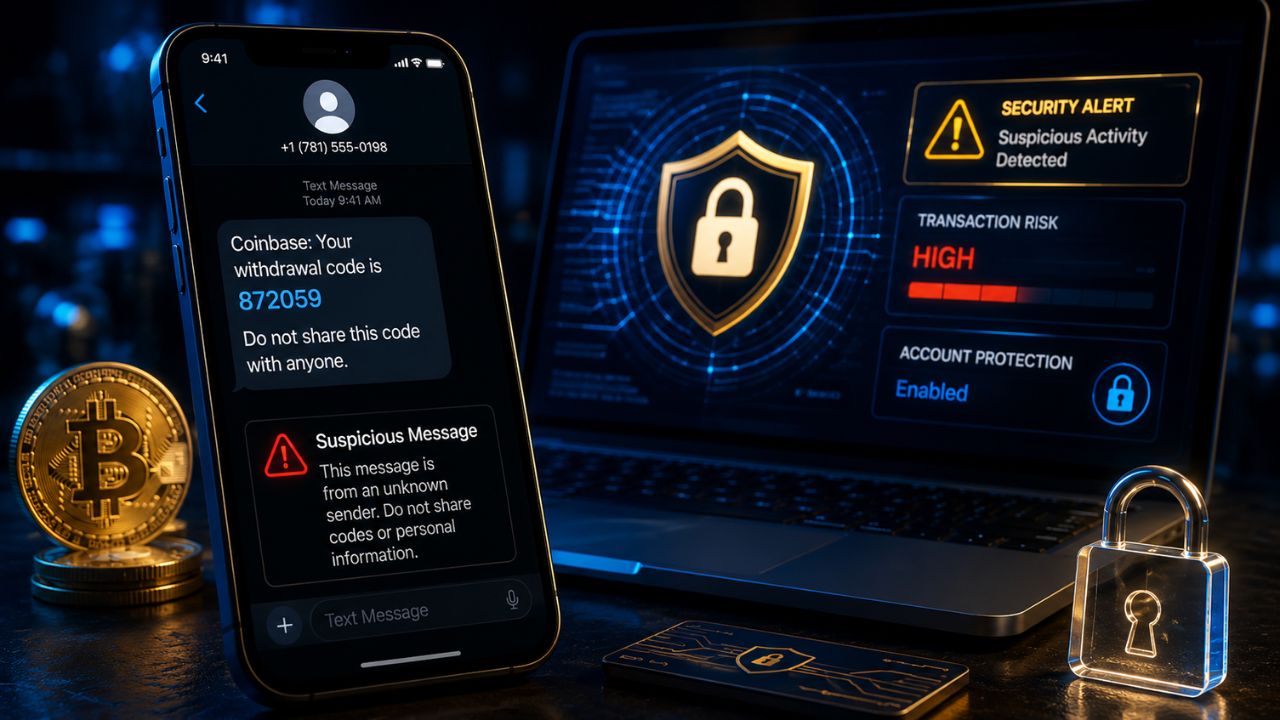
A coinbase withdrawal code text is a short message — delivered via SMS to your registered mobile number — that contains a one-time passcode (OTP) intended to authorize a withdrawal or other sensitive action on your Coinbase account. Under normal circumstances, this message is triggered only when you initiate a transaction yourself and have two-factor authentication (2FA) enabled.
These codes are time-sensitive (usually valid for just a few minutes) and are meant to be used only by you. No Coinbase employee, customer support agent, or third party will ever ask you to read a code back to them over the phone or paste it into a link.
Why These Texts Feel So Real
Scammers exploit a psychological trick called urgency engineering. When a coinbase withdrawal code text arrives unexpectedly, your brain immediately shifts into problem-solving mode: “Did someone access my account? Is my money being stolen right now?” That panic is exactly what a fraudster wants, because panicked people make fast, unverified decisions.
Caller ID spoofing technology allows criminals to make their call or text appear to originate from a legitimate number — sometimes the actual Coinbase support line. Combined with social engineering scripts rehearsed to sound professional and empathetic, these attacks are genuinely dangerous even for tech-savvy users.
Legitimate coinbase text messages from the real platform will come from a short code or verified sender ID, will never ask you to share the code verbally, and will never include a clickable link asking you to “re-verify” on a third-party site.
How to Recognize a Coinbase Scam Email
Email is the other major attack surface. A coinbase email scam typically arrives looking like an official Coinbase notification — complete with logos, brand colors, and professional formatting. The goal is always the same: get you to click a link, enter your credentials, or hand over a verification code.
Anatomy of a Coinbase Scam Email
Understanding the structure of coinbase scam emails helps you spot them instantly. Here’s what fraudulent messages typically contain:
- A spoofed sender address — e.g., support@coinbase-verify.net instead of @coinbase.com
- Subject lines designed to trigger fear: ‘Your account has been suspended’ or ‘Unusual login detected’
- A prominent ‘Verify Now’ or ‘Secure Your Account’ button linking to a phishing site
- Requests for your username, password, 2FA code, or coinbase withdrawal code text
- Artificial urgency: ‘You have 24 hours to respond or your account will be permanently locked’
- Generic greetings like ‘Dear User’ instead of your actual name
Real coinbase scam emails often pass a surface-level visual inspection — they look professional. The red flags are almost always buried in the sender address, the link URL, and the nature of the request itself.
The Sender Domain Is Everything
Coinbase exclusively uses @coinbase.com for official correspondence. Any email from a domain like coinbase-support.com, coinbase-alerts.net, or nocoinbase.io is fraudulent. Hover over any link in a suspicious email before clicking — the destination URL will tell you everything you need to know.
Coinbase Scam Text Messages: The SMS Threat
While email phishing has been around for decades, coinbase scam text attacks — also called smishing — have surged because people tend to trust SMS more than email. We’ve been conditioned to believe that a text on our personal phone is more intimate and therefore more legitimate than a marketing email.
A typical coinbase spam text might read: ‘COINBASE ALERT: A withdrawal of $2,500 has been requested from your account. If this wasn’t you, call us immediately at [fake number] or click [phishing link] to cancel.’ Every element of that message is engineered to make you act without thinking.
Common Coinbase Spam Text Patterns to Watch For
Recognizing these patterns is the single most effective way to protect yourself from a coinbase spam text attack:
- Texts claiming your account will be locked unless you verify immediately
- Messages containing shortened URLs (bit.ly, tinyurl) that hide the true destination
- Requests to call a phone number to ‘verify your identity’ or ‘cancel a transaction’
- Texts that include a code and ask you to read it to a ‘Coinbase representative’
- Messages congratulating you on a reward or bonus you never signed up for
One key distinction: when Coinbase legitimately sends a coinbase text message for 2FA, the message is short, clean, contains only the code and a brief instruction, and never includes a phone number to call or a link to click.
The Account Takeover Playbook: How the Scam Unfolds
Understanding the full sequence of a Coinbase account takeover helps you recognize when you’re being targeted — even mid-attack. Here is the step-by-step playbook most scammers follow:
Step 1 — Data Harvesting: Criminals purchase stolen credential lists from dark-web marketplaces. Your email and a weak or reused password may already be in one of these databases.
Step 2 — Credential Stuffing: Automated bots attempt to log in to Coinbase using those stolen credentials. If your password matches, they’re in — at least partially.
Step 3 — 2FA Bypass via Social Engineering: This is where the coinbase withdrawal code text comes in. The attacker triggers a real 2FA code from Coinbase’s system, then calls or texts you posing as a Coinbase security agent. They claim there’s suspicious activity on your account and ask you to ‘confirm your identity’ by reading back the code you just received.
Step 4 — Account Access: The moment you share that code, the attacker submits it to complete their login. Within seconds, they change your password, email, and 2FA settings — locking you out entirely.
Step 5 — Withdrawal: Crypto is moved to an external wallet that cannot be traced or reversed.
The entire process can take under five minutes. By the time most victims realize what happened, the crypto is gone — and because blockchain transactions are irreversible, recovery is nearly impossible.
Real vs. Fake: Side-by-Side Comparison
One of the best ways to protect yourself is to know exactly what a legitimate coinbase text looks like alongside a fraudulent one.
| Legitimate Coinbase Message | Scam / Phishing Message |
| Sender: Short code (e.g., 72658) or @coinbase.com | Sender: Random phone number, spoofed number, or fake domain |
| Content: Just a code + ‘Do not share this code’ | Content: Urgency, links, phone numbers, or requests to share the code |
| No links or clickable elements in 2FA texts | Contains shortened URLs or suspicious domain links |
| Never asks you to call a number | Includes a phone number to call ‘immediately’ |
| Addressed by your name in emails | Generic greeting: ‘Dear User’ or ‘Dear Customer’ |
What to Do If You Receive a Suspicious Coinbase Text Message
Receiving an unexpected coinbase text message doesn’t mean you’ve already been compromised — but it does mean you need to act calmly and methodically. Here’s exactly what to do:
• Do not click any links: Phishing links can install malware or redirect you to credential-harvesting sites that look identical to Coinbase’s real login page.
• Do not call any number in the message: Scammers staff fake call centers. Calling the number in a suspicious text connects you directly to a criminal.
• Do not share the code with anyone: No Coinbase employee will ever ask for your 2FA code. Ever. Full stop.
• Go directly to coinbase.com by typing it yourself: Never use links from emails or texts. Always navigate directly to the platform.
• Check your account activity: Log in through the official app or website and review recent transactions and login attempts.
• Change your password immediately: If you suspect any compromise, update your password and 2FA settings right away.
• Report the message to Coinbase: Forward suspicious emails to security@coinbase.com and report phishing texts through your phone’s messaging app.
How to Secure Your Coinbase Account Against Future Attacks
Prevention is far more effective than recovery in the world of crypto. Once your assets are gone, they are almost certainly unrecoverable. These security practices form a robust defense against coinbase scam text attacks, phishing emails, and account takeover attempts.
Use a Hardware Security Key Instead of SMS 2FA
SMS-based 2FA — the kind that sends a coinbase withdrawal code text to your phone — is the weakest form of two-factor authentication. SIM swapping attacks can reroute your text messages to a scammer’s device without your knowledge. Upgrading to a hardware security key (such as a YubiKey) or an authenticator app (Google Authenticator, Authy) eliminates the risk of code interception entirely.
Enable a Strong, Unique Password
If you use the same password for Coinbase that you use for other accounts, a breach on any of those platforms can cascade into a Coinbase compromise. Use a password manager to generate and store a unique, 20+ character password for your crypto exchange accounts.
Monitor Account Activity Regularly
Coinbase provides a full activity log in your account settings. Review it weekly. Unfamiliar IP addresses, logins from new devices, or small test withdrawals are early warning signs that someone has your credentials.
Set Up a Withdrawal Address Whitelist
Coinbase allows users to whitelist specific withdrawal addresses. When this feature is enabled, funds can only be sent to pre-approved wallets — even if a scammer gains access to your account. It adds a 48-hour delay for adding new addresses, which is often enough time to catch and reverse unauthorized changes.
The Psychology Behind Crypto Scams: Why Smart People Fall For Them
It would be easy to assume that only careless or technologically naive people fall for a coinbase email scam or fake coinbase scam text. The reality is far more sobering. Security researchers and law enforcement agencies have documented cases of software engineers, financial professionals, and even cybersecurity experts losing money to these schemes.
The reason is neurological, not intellectual. Scammers deliberately engineer scenarios that hijack the brain’s fight-or-flight response. When you believe your life savings are being drained in real time, the rational prefrontal cortex takes a back seat to the amygdala — the part of the brain that screams “Act now, think later.”
Urgency and Authority: The Two-Headed Monster
Virtually every successful coinbase scam email combines two psychological triggers: urgency (“Your account will be locked in 60 minutes”) and authority (“This is Coinbase Security calling”). Together, these create a mental state where following instructions feels more rational than stopping to verify.
The antidote is a deliberate pause. Before responding to any message that claims to be from Coinbase — whether it arrives as a coinbase spam text, an email, or a phone call — give yourself five minutes to verify through official channels. That pause can mean the difference between keeping and losing your assets.
Reporting Coinbase Scam Emails and Texts: Making a Difference
Reporting suspicious messages isn’t just good practice — it actively helps protect the broader crypto community. Here are the channels you should use:
• Coinbase Security Team: Forward coinbase scam emails directly to security@coinbase.com. Include the full email header for maximum usefulness to their fraud team.
• FTC (Federal Trade Commission): File a complaint at reportfraud.ftc.gov. The FTC tracks patterns and uses reports to build cases against criminal networks.
• FBI Internet Crime Complaint Center (IC3): Submit a complaint at ic3.gov, especially if you’ve suffered a financial loss. The IC3 coordinates with federal law enforcement.
• Your Mobile Carrier: Forward suspicious texts to 7726 (SPAM) — this is a universal short code that all major carriers use to analyze and block smishing campaigns.
• Your State’s Attorney General: Many states have dedicated cybercrime units. A quick search for ‘[your state] attorney general cyber fraud’ will find the right reporting portal.
What Coinbase Will and Will Never Do
A clear understanding of Coinbase’s actual communication policies helps cut through the confusion created by sophisticated fakes. Here are Coinbase’s verified practices, drawn directly from their official security documentation:
Coinbase Will:
- Send automated 2FA codes via SMS (a real coinbase text message) when you initiate login or a sensitive action
- Email you from @coinbase.com domains only
- Notify you of account changes (password resets, new device logins) via email
- Provide in-app notifications for transactions and security events
Coinbase Will Never:
- Ask you to share a 2FA code or coinbase withdrawal code text over phone, chat, or email
- Call you unsolicited about account security
- Ask for your password, seed phrase, or private keys under any circumstances
- Send coinbase scam emails asking you to click emergency links
- Request remote access to your device
- Ask you to send crypto to a ‘secure wallet’ to protect your funds
Frequently Asked Questions
Why did I receive a coinbase withdrawal code text that I didn’t request?
If you received an unsolicited coinbase withdrawal code text, it most likely means someone has obtained your login credentials and attempted to log in to your account, triggering the real 2FA system. Change your Coinbase password immediately, review your account activity, and do not share the code with anyone. Enable a stronger 2FA method such as an authenticator app.
How can I tell if a coinbase email scam is fake?
Inspect the sender’s email address carefully — legitimate Coinbase emails come exclusively from @coinbase.com. A coinbase email scam will typically use a similar-looking domain (coinbase-alerts.com, etc.). Also look for generic greetings, urgent language, and links that don’t point to coinbase.com when you hover over them.
What should I do if I already clicked a link in a coinbase scam email?
Act immediately. Change your Coinbase password and your email account password. Check whether any withdrawals have been initiated. Enable 2FA if you haven’t already. Run a malware scan on your device. Report the coinbase scam email to security@coinbase.com and the FTC.
Is a coinbase text message always from Coinbase?
No. Scammers can spoof sender IDs to make a coinbase text message appear to come from a legitimate source. Always verify unexpected messages by logging in directly to your Coinbase account through the official app or by typing coinbase.com into your browser.
What is coinbase spam text and how does it differ from phishing?
A coinbase spam text is an unsolicited message that typically promotes a fake giveaway, reward, or offers to help you recover an account. Phishing texts are more targeted and try to steal specific credentials. Both are dangerous, but phishing texts typically require more engagement from the victim.
Can I recover crypto stolen through a coinbase scam text?
Unfortunately, blockchain transactions are irreversible. If you were deceived by a coinbase scam text and funds were withdrawn, recovery through Coinbase is generally not possible. However, you should still report the incident to Coinbase, the FTC, and local law enforcement. In some cases, exchanges can freeze assets if reported quickly enough before they’re moved off-platform.
Does Coinbase ever call customers about suspicious activity?
Coinbase does not make unsolicited outbound calls to customers. If you receive a call from someone claiming to be Coinbase support, hang up. You can always initiate contact yourself through the official Support section on coinbase.com.
How do I stop coinbase spam text messages?
Block the sender on your phone and report the number to your carrier by forwarding it to 7726. You can also report it to the FTC at reportfraud.ftc.gov. On your Coinbase account, ensure your phone number is current and hasn’t been transferred to a scammer through a SIM swap attack.
Conclusion
Crypto fraud is not a fringe problem. It is a multi-billion-dollar criminal industry that preys on ordinary people, and Coinbase’s popularity makes it a perennial target. Whether it arrives as a coinbase withdrawal code text you didn’t request, a polished coinbase scam email in your inbox, or a panicked coinbase scam text urging you to act within minutes — the playbook is always the same: create fear, manufacture urgency, and get you to hand over access before you stop to think.
The single most powerful defense isn’t technology — it’s knowledge. Now that you understand exactly how these attacks work, you are far less likely to fall for them. You know that a real coinbase text message will never ask you to share a code. You know that coinbase scam emails can look pixel-perfect but betray themselves in the sender domain. You know that the right response to any unexpected coinbase spam text is to pause, verify through official channels, and never act under pressure.
Secure your account today. Upgrade your 2FA method. Enable the withdrawal address whitelist. Review your recent activity. Share this guide with friends and family who hold crypto — because awareness is contagious, and so is good security hygiene. Your future self will thank you.