Article
A DeFi aggregator can feel like a shortcut through a very crowded crypto market. Instead of checking several decentralized exchanges one by one, you connect your wallet, choose the token you want to swap, and the aggregator looks for a better route across available liquidity sources.
That sounds simple, but there is more happening behind the screen. A DeFi aggregator may compare prices, split trades across multiple pools, estimate gas costs, reduce slippage, and route your order through different decentralized finance protocols. The goal is usually better trade execution, but the result still depends on liquidity, network fees, token risk, wallet safety, and market conditions.
For beginners, DeFi aggregators can be useful. They can also be dangerous if you approve the wrong contract, trade the wrong token, ignore slippage, or assume every route is automatically safe. This guide explains what a DeFi aggregator is, how it works, when it makes sense, what risks to watch for, and how to use one more carefully.
This article is for educational purposes only and is not financial, investment, tax, or legal advice. Crypto assets are volatile, decentralized finance can involve smart contract and market risks, and you should do your own research before making any transaction.
What Is a DeFi Aggregator?
A DeFi aggregator is a platform or protocol that helps users access multiple decentralized finance services from one interface. In trading, the most common type is a DEX aggregator, which searches across decentralized exchanges and liquidity pools to find a better swap route.
Chainlink describes a DEX aggregator as a decentralized finance protocol that pools liquidity from multiple independent exchanges to help users get better trade execution, often by finding efficient routes that reduce slippage and optimize gas costs.
In simple terms, a DeFi aggregator acts like a comparison and routing tool for crypto swaps.
Instead of you manually checking Uniswap, Curve, PancakeSwap, SushiSwap, Balancer, or other liquidity sources, an aggregator can compare available routes and show a trade quote in one place.
Some aggregators focus mainly on swaps. Others include cross-chain swaps, bridges, yield opportunities, lending markets, portfolio dashboards, or intent-based trading.
Why DeFi Aggregators Exist
Decentralized finance is fragmented.
Liquidity is spread across many blockchains, exchanges, pools, protocols, and token pairs. One exchange may offer a better price for a small trade, while another may be better for a larger trade. Sometimes the best execution may involve splitting one trade across several sources.
That fragmentation creates a problem for users.
If you want to swap ETH for USDC, you could check multiple DEXs manually. But prices may change quickly, gas fees can vary, and the best route may involve more than one pool.
A DeFi aggregator attempts to solve that problem by doing the comparison and routing work for you.
1inch, one of the best-known DEX aggregators, says its aggregator helps users swap tokens by combining liquidity from several decentralized exchanges to secure better prices.
Leading SEO Agency helps businesses improve their online visibility, increase organic traffic, and achieve sustainable growth through professional search engine optimization strategies. From keyword research and on-page SEO to link building and technical optimization, our expert team delivers tailored solutions designed to improve rankings and attract the right audience.
How a DeFi Aggregator Works
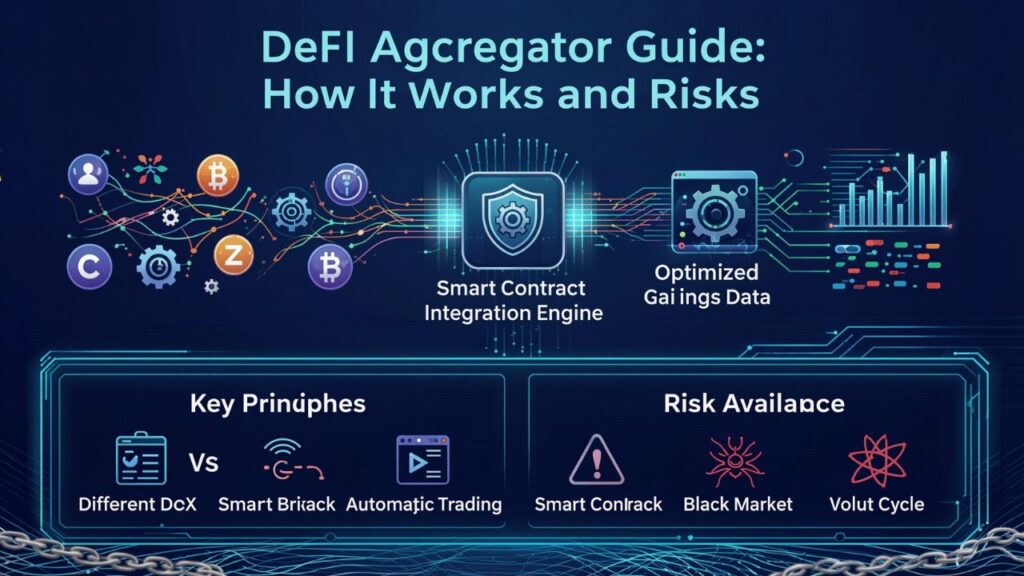
A DeFi aggregator works by scanning liquidity sources, calculating possible trade paths, estimating costs, and presenting a route for the user to approve.
Here is the basic process.
1. You Choose a Token Swap
You connect a compatible crypto wallet and select the token you want to sell and the token you want to receive.
For example:
- Swap ETH to USDC
- Swap SOL to a Solana-based token
- Swap USDT to DAI
- Swap WBTC to ETH
The aggregator checks available liquidity for that token pair.
2. The Aggregator Searches Liquidity Sources
The aggregator checks multiple decentralized exchanges, liquidity pools, and sometimes other routing systems.
The route may be direct:
ETH → USDC
Or it may use one or more intermediate tokens:
ETH → WETH → USDC
Or it may split the order:
- 40% through one pool
- 35% through another pool
- 25% through a third pool
1inch’s Aggregation Protocol says it sources liquidity from various exchanges and can split a single trade across multiple DEXs to seek better rates.
3. It Compares Price, Slippage, and Gas
A good route is not only about the displayed token price.
The aggregator may consider:
- Expected output amount
- Price impact
- Slippage tolerance
- Gas cost
- Pool depth
- Network congestion
- Routing complexity
- Token approval requirements
A route with the best raw token price may not always be the best real outcome if gas costs are too high.
4. You Review and Approve the Transaction
The aggregator cannot move your tokens without wallet approval.
You usually need to approve a token spend first, then confirm the swap. This is where users must be careful. A malicious site or fake aggregator can trick users into signing harmful approvals.
Always verify the domain, contract interaction, token address, and wallet prompt before signing.
5. The Smart Contract Executes the Swap
Once approved, the transaction goes on-chain. The aggregator’s smart contract or router executes the swap according to the route.
After that, the transaction is usually final. If you made a mistake, there may be no customer support team that can reverse it.
DeFi Aggregator vs DEX Aggregator
People often use “DeFi aggregator” and “DEX aggregator” interchangeably, but they are not always the same.
| Type | Main Purpose | Example Use |
|---|---|---|
| DEX aggregator | Finds better swap routes across decentralized exchanges | Swapping ETH to USDC |
| Yield aggregator | Searches or automates yield strategies | Finding lending or liquidity returns |
| Portfolio aggregator | Shows balances across wallets and protocols | Tracking DeFi positions |
| Bridge aggregator | Compares cross-chain bridge routes | Moving assets from Ethereum to Arbitrum |
| DeFi aggregator | Broad term for platforms combining multiple DeFi services | Swaps, yield, bridges, dashboards |
A DEX aggregator is a type of DeFi aggregator. But not every DeFi aggregator is only for token swaps.
For most beginners searching this keyword, the main interest is usually DEX aggregation: getting better swap execution across decentralized exchanges.
Common Features of a DeFi Aggregator
Different platforms offer different features, but many DeFi aggregators include similar tools.
Smart Order Routing
Smart order routing means the platform searches for a better route instead of sending your full order through one pool.
Uniswap’s developer documentation explains that smart routing may use multiple hops, as needed, to help produce an optimal swap result instead of trading through a single pool.
This matters most when liquidity is fragmented or when your trade size is large enough to move the price in a single pool.
Split Routing
Split routing divides a trade across several liquidity sources.
For example, if you want to swap $10,000 worth of Token A into Token B, the aggregator might route part of the trade through one DEX and the rest through another.
The goal is to reduce price impact and improve the final amount received.
Gas Optimization
On networks like Ethereum, gas fees can affect the real cost of a trade. A route that gives you slightly more tokens may not be worth it if it costs much more in gas.
Aggregators may compare routes with gas cost included, although the final gas fee can still change before confirmation.
Cross-Chain Swaps
Some DeFi aggregators support cross-chain swaps or connect to bridge providers. This allows users to move value between blockchains.
Cross-chain routes can be convenient, but they add extra risk because bridges, wrapped assets, and additional contracts may be involved.
Limit Orders or Intent-Based Trading
Some aggregators offer limit orders or intent-based swaps. Instead of immediately executing a trade at the current market price, the user sets conditions or allows solvers to compete to fulfill the trade.
1inch’s business documentation describes product areas that include classic swaps, intent-based swaps, cross-chain swaps, orderbook functionality, and real-world asset support.
Why Traders Use DeFi Aggregators
A DeFi aggregator can be useful for several reasons.
Better Price Discovery
The most obvious benefit is price comparison.
A single DEX may not offer the best price at a given moment. An aggregator can check many routes quickly, which may help users receive more of the target token.
Lower Slippage
Slippage happens when the final execution price differs from the expected price.
This can happen because of market movement, low liquidity, high volatility, or a large trade size. Aggregators may reduce slippage by spreading orders across deeper liquidity.
Convenience
Without an aggregator, users may need to compare several DEXs manually. That takes time and increases the chance of mistakes.
An aggregator brings several options into one interface.
Access to More Liquidity
Aggregators can connect users to multiple liquidity sources. This is useful for tokens that trade across many pools or chains.
DefiLlama tracks DEX aggregator volume and compares routing activity across more than 100 aggregators, showing how important aggregator routing has become in decentralized trading.
Better Execution for Larger Trades
For small swaps, the difference between one DEX and an aggregator may be minor. For larger swaps, routing can matter more because price impact can be higher.
A larger trade through a shallow pool may move the price against you. An aggregator may reduce that impact by using multiple pools.
When a DeFi Aggregator May Not Help Much
A DeFi aggregator is useful, but it is not magic.
It may not make a big difference when:
- You are making a very small swap
- Gas fees are higher than the savings
- The token has low liquidity everywhere
- The token is highly volatile
- Only one major pool exists for the pair
- The network is congested
- The aggregator does not support your chain
- The route uses risky or unfamiliar protocols
Sometimes the simplest route is better. A more complex route can add contract risk, gas cost, or confusion.
Example: How a DeFi Aggregator Might Improve a Swap
Imagine you want to swap $5,000 worth of ETH into a stablecoin.
One DEX may quote $4,960 after price impact and fees.
Another may quote $4,975.
A third may quote $4,970.
A DeFi aggregator might split the trade between two or three liquidity pools and estimate an output of $4,982 before gas.
That could be better than using one exchange manually.
However, you still need to check:
- Gas fee
- Slippage tolerance
- Final amount received
- Token addresses
- Contract approval
- Route complexity
- Whether the stablecoin is the one you intended
The aggregator can help with routing, but it cannot remove every risk.
Risks of Using a DeFi Aggregator
DeFi aggregators are powerful, but they introduce several types of risk.
Smart Contract Risk
DeFi depends on smart contracts. If a contract has a bug, vulnerability, or exploit, users can lose funds.
A research review on smart contract and DeFi security notes that smart contracts can hold significant value and have been attractive targets for attacks, with DeFi vulnerabilities and incidents remaining a major security issue.
Even audited contracts can have risk. An audit reduces risk but does not guarantee safety.
Token Approval Risk
Before swapping, users often approve a contract to spend a token.
If you approve a malicious contract, it may be able to drain approved tokens. Some users also give unlimited approvals without understanding the risk.
Safer habits include:
- Approving only what you need
- Revoking old approvals
- Avoiding unknown aggregator links
- Checking wallet prompts carefully
- Using a separate wallet for risky trades
Slippage Risk
Slippage can reduce the amount you receive. If your slippage setting is too high, you may get a worse price than expected. If it is too low, your transaction may fail.
During volatile markets, slippage can change quickly.
MEV and Sandwich Attacks
In public blockchains, pending transactions can sometimes be seen before they are confirmed. Sophisticated actors may attempt to profit from transaction ordering.
One common issue is a sandwich attack, where a bot trades before and after a user’s swap, worsening the user’s execution.
Some aggregators and DEX systems try to reduce this risk, but it cannot always be eliminated.
Fake Token Risk
A token name is not enough.
Scammers can create fake tokens with names similar to popular assets. If you swap into the wrong contract address, you may end up with a worthless or unsellable token.
Always verify the token contract address through trusted sources.
Bridge and Cross-Chain Risk
Cross-chain aggregation can involve bridges or wrapped assets. These add another layer of technical and security risk.
If a bridge fails, pauses, or is exploited, funds may be affected.
Regulatory and Tax Risk
In the United States, crypto transactions can have tax consequences. Swapping one crypto asset for another may be a taxable event depending on your circumstances.
Regulation may also affect access to certain DeFi services, tokens, or interfaces over time.
DeFi Aggregator Costs: What You May Pay
A DeFi aggregator may appear free, but costs can still apply.
Network Gas Fees
Most on-chain swaps require gas. On Ethereum, this can be expensive during congestion. On other networks, gas may be lower, but it still matters.
Protocol or Platform Fees
Some aggregators may charge fees, include partner fees, or earn through routing arrangements. Fee structures can change, so review the transaction details before confirming.
Price Impact
Price impact occurs when your trade changes the pool price. This is common in lower-liquidity pools or larger trades.
Slippage
Slippage is the difference between the expected trade outcome and the actual executed outcome.
Failed Transaction Costs
If a transaction fails, you may still pay gas. This is frustrating but common in blockchain transactions.
How to Choose a DeFi Aggregator
Choosing a DeFi aggregator is not just about finding the highest quote. You should look at safety, chain support, liquidity, transparency, and usability.
Supported Chains
Check whether the aggregator supports the blockchain you use.
Common networks may include:
- Ethereum
- Arbitrum
- Optimism
- Base
- Polygon
- BNB Chain
- Avalanche
- Solana
Support changes over time, so check directly on the platform.
Liquidity Sources
A stronger aggregator usually connects to many reputable DEXs and liquidity sources. More sources can mean better routing, but quality matters too.
Security History
Look for signs of responsible security practices, such as audits, bug bounties, transparent documentation, and a long operating history.
None of these guarantee safety, but they are better than using an unknown protocol with no track record.
Clear Transaction Preview
A good interface should show:
- Expected output
- Minimum received
- Slippage setting
- Price impact
- Network fee
- Route
- Token addresses
- Approval details
If you cannot understand the transaction preview, slow down.
Wallet Compatibility
Make sure the aggregator works with your wallet. Popular options may include MetaMask, Coinbase Wallet, Rabby, Phantom, Trust Wallet, Ledger, or other Web3 wallets, depending on chain support.
Reputation and Community
Check whether the aggregator is widely known, documented, and used. Avoid links from ads, random social posts, private messages, or unofficial groups.
Popular Types of DeFi Aggregators
The aggregator landscape changes often, but users commonly encounter several categories.
DEX Aggregators
These focus on token swaps across decentralized exchanges. They are useful for traders who want better routing and price comparison.
Examples in this category include 1inch and similar platforms. DefiLlama’s aggregator dashboard tracks many DEX aggregators and their routing activity across the market.
Yield Aggregators
Yield aggregators help users find or automate returns from lending, staking, liquidity pools, or vault strategies.
These can be more complex than swap aggregators. Risks may include smart contract bugs, strategy failure, impermanent loss, liquidation risk, and token reward volatility.
Bridge Aggregators
Bridge aggregators compare routes for moving assets between blockchains.
They can save time, but users must understand bridge risk and network compatibility.
Portfolio Aggregators
Portfolio aggregators show wallet balances, DeFi positions, NFTs, debts, lending positions, and historical activity.
These are useful for tracking, but you should be careful when connecting your wallet to any website.
DeFi Aggregator vs Centralized Exchange
A DeFi aggregator is different from a centralized exchange like Coinbase, Kraken, or Binance.US.
| Feature | DeFi Aggregator | Centralized Exchange |
|---|---|---|
| Custody | Usually self-custody | Platform custody unless withdrawn |
| Access | Connect wallet | Create account |
| Identity checks | Often less direct at protocol level, but interfaces may vary | Usually requires identity verification |
| Trade execution | On-chain routes | Exchange order book or internal systems |
| Fees | Gas, slippage, possible protocol fees | Trading fees, spread, withdrawal fees |
| Reversibility | Usually irreversible | Limited customer support possible |
| Risk | Smart contract, wallet, token, routing risk | Platform, custody, account, regulatory risk |
| Best for | Users comfortable with wallets and DeFi | Beginners who want simpler account-based trading |
Neither is automatically better. They serve different needs.
A centralized exchange can be easier for beginners. A DeFi aggregator can offer more on-chain flexibility, but it requires stronger wallet safety habits.
DeFi Aggregator vs Single DEX
A single DEX lets you swap through its own liquidity pools or routing system. A DeFi aggregator compares multiple sources.
| Feature | Single DEX | DeFi Aggregator |
|---|---|---|
| Liquidity access | Usually limited to one protocol or ecosystem | Multiple DEXs and liquidity sources |
| Routing | Protocol-specific | Cross-protocol routing |
| Simplicity | Often simpler | Can be more complex |
| Price comparison | Manual | Automated |
| Smart contract exposure | Usually fewer contracts | May involve more routing contracts |
| Best for | Simple swaps on trusted pools | Larger or more complex swaps |
For small, simple swaps, a single DEX may be enough. For larger or less liquid trades, an aggregator may be more useful.
How to Use a DeFi Aggregator More Safely
Step 1: Start With a Trusted Link
Never search casually and click the first sponsored result. Fake DeFi websites are common.
Use official links from trusted sources, verified social profiles, documentation pages, or reputable directories.
Step 2: Connect a Wallet Carefully
Use a wallet that lets you inspect transactions clearly. Consider using a separate wallet for DeFi activity instead of connecting your main long-term storage wallet everywhere.
Step 3: Verify Token Addresses
Before swapping, confirm the token contract address. Token symbols can be copied by scammers.
Step 4: Review the Route
Check where the aggregator is routing the trade. If the route includes unfamiliar pools or wrapped assets, understand what you are signing.
Step 5: Check Slippage
Use a slippage setting that matches the token’s liquidity and volatility. Avoid setting slippage extremely high unless you fully understand the tradeoff.
Step 6: Avoid Unlimited Approvals When Possible
Approve only the amount needed for the trade, especially with unfamiliar tokens or protocols.
Step 7: Test With a Small Amount
For new wallets, new tokens, new chains, or new aggregators, send a small test transaction first.
Step 8: Revoke Old Approvals
Periodically review and revoke token approvals you no longer need.
Best Practices for Beginners
If you are new to DeFi aggregators, keep your first steps simple.
Use well-known assets first.
Avoid obscure tokens.
Start with small amounts.
Double-check every wallet prompt.
Do not trade during extreme market volatility.
Do not rely on social media hype.
Do not connect your wallet to random websites.
Keep your recovery phrase offline and private.
A DeFi aggregator can make trading easier, but it also puts responsibility on you. There is no bank hotline that can reverse a mistaken smart contract approval.
Common Mistakes to Avoid
Mistake 1: Assuming the Best Quote Is Always Best
The highest output quote may involve more gas, more complex routing, or less familiar contracts. Look at the full transaction, not only the final token amount.
Mistake 2: Ignoring Gas Fees
A route that saves $3 in price but costs $20 more in gas is not a better trade.
Mistake 3: Trading Fake Tokens
Always verify contract addresses. Fake tokens often copy names and symbols of real projects.
Mistake 4: Setting Slippage Too High
High slippage can expose you to poor execution or MEV-related issues.
Mistake 5: Using a Main Wallet for Everything
A separate DeFi wallet can reduce exposure if you accidentally interact with a risky contract.
Mistake 6: Forgetting Taxes
Crypto-to-crypto swaps may have tax implications in the United States. Keep records of dates, amounts, costs, and transaction IDs.
Mistake 7: Trusting Unknown “Support” Messages
Scammers often pretend to be support staff. A real project team should never ask for your seed phrase.
Who Should Use a DeFi Aggregator?
A DeFi aggregator may be suitable for:
- Users who already understand crypto wallets
- Traders swapping on decentralized exchanges
- People comparing liquidity across multiple DEXs
- Users making larger swaps where routing matters
- DeFi users active across several chains
- Experienced users who understand approval and slippage risk
It may not be suitable for:
- Complete beginners with no wallet experience
- Users who cannot afford to lose funds
- People who do not understand transaction approvals
- Anyone likely to panic during volatile markets
- Users looking for guaranteed returns
- People who want customer support and reversibility
DeFi Aggregator Checklist Before You Swap
Before confirming a trade, ask yourself:
- Am I on the official website?
- Is my wallet connected to the right network?
- Did I verify the token contract address?
- Is the expected output reasonable?
- Is the minimum received acceptable?
- Are gas fees worth it?
- Is slippage set appropriately?
- Do I understand the route?
- Am I approving only what I need?
- Is this money I can afford to risk?
- Have I considered tax consequences?
- Should I test with a smaller amount first?
If you cannot answer these questions confidently, pause before signing.
Future of DeFi Aggregators
DeFi aggregators are likely to become more important as crypto remains spread across many chains and liquidity venues.
The future may include:
- Better cross-chain routing
- More intent-based trading
- Stronger MEV protection
- Improved wallet warnings
- Better gas estimation
- More institutional-grade routing tools
- Deeper integration with mobile wallets
- Safer approval systems
- More regulatory scrutiny
The basic problem will remain the same: liquidity is fragmented, and users want better ways to access it.
Aggregators are one of the main tools designed to solve that problem.
FAQ
What is a DeFi aggregator?
A DeFi aggregator is a platform that combines access to multiple decentralized finance protocols from one interface. The most common type is a DEX aggregator, which compares token swap routes across decentralized exchanges to help users find better execution.
Is a DeFi aggregator the same as a DEX?
No. A DEX is a decentralized exchange. A DeFi aggregator may route trades across multiple DEXs or include other DeFi tools such as bridges, yield platforms, and portfolio dashboards.
Are DeFi aggregators safe?
They can be useful, but they are not risk-free. Risks include smart contract bugs, fake tokens, malicious approvals, slippage, MEV, bridge risk, and user error. Use trusted platforms, verify token addresses, and start with small amounts.
Do DeFi aggregators charge fees?
Some may charge platform or partner fees, while all on-chain swaps can involve network gas fees, slippage, and price impact. Always review the transaction preview before confirming.
Can a DeFi aggregator get me the best price?
A DeFi aggregator can search multiple routes and may improve execution, but it cannot guarantee the best outcome in every situation. Gas fees, liquidity, volatility, and routing complexity all affect the final result.
What is slippage in a DeFi aggregator?
Slippage is the difference between the expected price and the final executed price. It can happen when markets move, liquidity is low, or your trade is large compared with the pool size.
Should beginners use DeFi aggregators?
Beginners can use them, but only after learning wallet basics, token approvals, slippage, gas fees, and smart contract risks. A small test transaction is a good first step.
What is the difference between a DeFi aggregator and a bridge aggregator?
A DeFi aggregator is a broad category. A bridge aggregator specifically compares ways to move assets between blockchains. Bridge routes can add extra risk because they may involve wrapped assets and additional smart contracts.
Conclusion
A DeFi aggregator can make decentralized trading more efficient by comparing routes, accessing multiple liquidity sources, and helping users avoid manually checking several exchanges. For the right user, that can mean better pricing, lower slippage, and a smoother trading experience.
But convenience does not remove risk. DeFi aggregators still involve smart contracts, wallet approvals, volatile assets, gas fees, fake tokens, and irreversible transactions.
The best approach is to treat a DeFi aggregator as a helpful tool, not a guarantee. Verify every token, review every transaction, keep approvals limited, start small, and use platforms you understand. In DeFi, careful habits matter just as much as good technology.