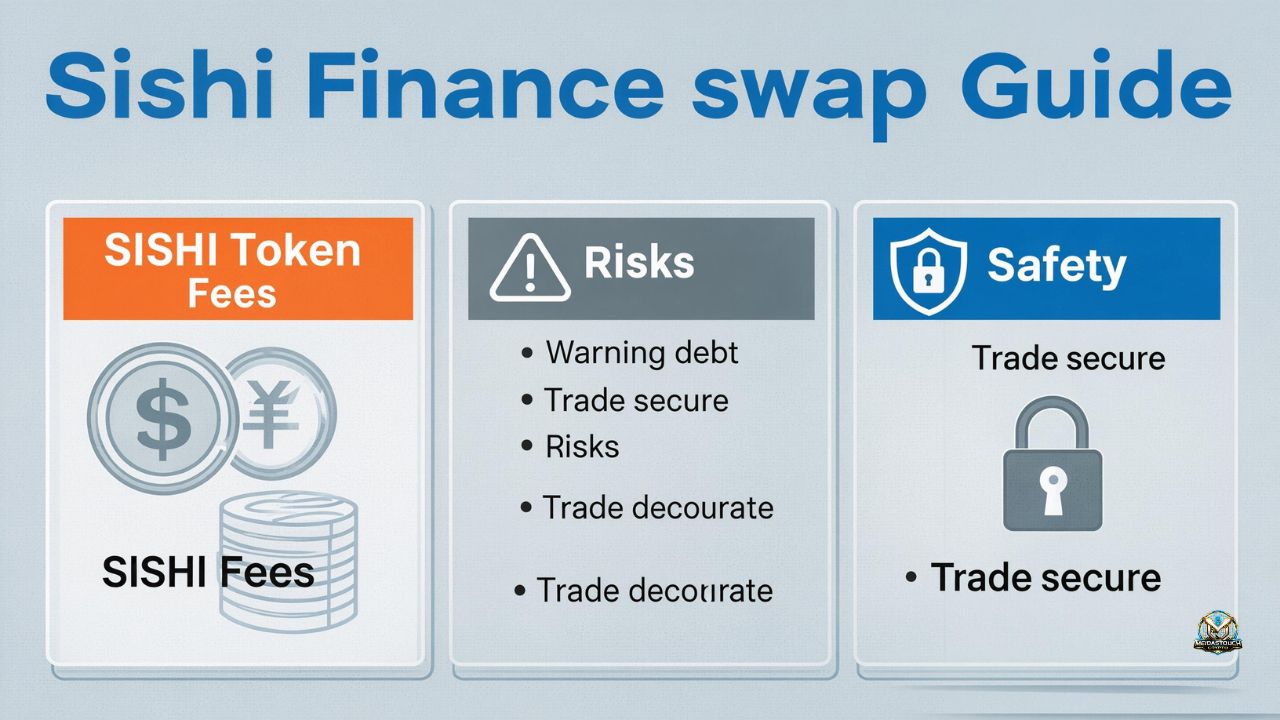
Crypto has a strange talent for turning one small search into a rabbit hole. You look up sishi finance swap, expecting a simple “how to buy or sell” answer, and suddenly you are staring at contract addresses, liquidity pools, slippage settings, BNB gas fees, tiny trading volume, and half-familiar DeFi terms that sound simple until real money is involved.
That is exactly why this topic matters. Sishi Finance is not a giant, highly liquid crypto asset like Bitcoin, Ethereum, or BNB. It is a small DeFi token on BNB Smart Chain, and small tokens can behave very differently from mainstream coins. A swap may go through smoothly, but it may also suffer from poor liquidity, price impact, outdated information, or simple user mistakes.
This guide walks through the topic in plain English. We will cover what Sishi Finance is, how swapping works, what current market data suggests, which risks deserve attention, and how a cautious user would approach the transaction. The goal is not hype. The goal is clarity.
Table of Contents
- What Is Sishi Finance?
- How sishi finance swap Works
- SISHI Token Snapshot and Market Data
- Why Liquidity Matters Before Swapping
- Wallet Setup and Contract Verification
- Fees, Slippage, and Price Impact
- Benefits People Look For
- Major Risks and Red Flags
- Team Background, Achievements, and Financial Insights
- Practical Example: A Safer SISHI Swap Flow
- FAQ
- Conclusion
What Is Sishi Finance?
Sishi Finance is a cryptocurrency project associated with the SISHI token. Coinbase’s Sishi Finance listing describes SISHI as a cryptocurrency launched in 2021 that operates on the BNB Smart Chain BEP20 platform. The same listing shows the BNB Smart Chain contract address as 0x8E8538c75f273aB2dF6AdEEcD3622A9c314fcCf3, with a max supply of 21 million SISHI and a total supply around 170K SISHI.
That already tells us several useful things. First, this is not an Ethereum mainnet ERC-20 token in the usual sense. It is a BEP20 token on BNB Smart Chain. Second, anyone researching a swap must verify the token contract carefully, because small tokens are often copied by lookalike contracts. Third, the market appears extremely small compared with active DeFi tokens.
CoinMarketCap lists Sishi Finance with a live price around fractions of a cent, unavailable 24-hour trading volume, unavailable circulating supply, and a max supply of 21,000,000 SISHI. Binance’s price page also shows a current market cap of $0, 24-hour trading volume of $0, and circulating supply of 0, while noting a historical all-time high of $7.29.
In everyday language, that means SISHI should be treated as a very small, thinly traded DeFi asset. It may still be swappable through certain BNB Chain routes, but the trading experience will not feel like swapping ETH, USDT, or BNB.
How sishi finance swap Works
A sishi finance swap is the process of exchanging another crypto asset, usually BNB or a BNB Chain token, for SISHI, or exchanging SISHI back into another asset. Because SISHI is on BNB Smart Chain, the swap usually depends on a BNB Chain wallet, BNB for gas, and a decentralized exchange route such as a PancakeSwap V2 pair or a swap aggregator.
The basic flow looks simple:
- Open a BNB Chain-compatible wallet.
- Make sure the wallet is connected to BNB Smart Chain.
- Hold enough BNB to cover gas fees.
- Import or verify the correct SISHI token contract.
- Choose the token you are swapping from.
- Review the quote, liquidity, slippage, and minimum received.
- Confirm the transaction in your wallet.
- Check the transaction on BscScan.
However, the simple version hides the real work. The important part is not clicking “swap.” The important part is making sure the asset, network, contract, and liquidity are correct before you sign anything.
Centralized Listings vs. On-Chain Swaps
Some crypto pages show a price for SISHI, but that does not always mean the asset is actively available on major exchanges. Price tracking pages can display assets with weak or nearly inactive markets. On-chain swap tools may still find a route, but that route can be expensive or unstable if the liquidity pool is small.
Here is a practical comparison:
| Swap Method | How It Works | Main Advantage | Main Risk |
|---|---|---|---|
| DEX swap | Trade through a BNB Chain pool | Self-custody and direct access | Low liquidity and price impact |
| Swap aggregator | Searches routes across pools | May find a better route | Still depends on available liquidity |
| Centralized exchange | Deposit and trade through an exchange | Easier interface if listed | May not support SISHI trading |
| Manual peer transfer | Direct wallet-to-wallet deal | Flexible | High trust risk and no order book |
For most users, the safest route begins with research, not execution.
SISHI Token Snapshot and Market Data
Before using sishi finance swap tools, look at the market honestly. A tiny token can move sharply, but it can also become difficult to exit. That is not a scare tactic. It is basic market structure.
ApeSpace shows SISHI trading against WBNB on PancakeSwap V2, with very low reported 24-hour volume, about $2.29K in liquidity, around 3.1K holders, and a low-liquidity warning explaining that low liquidity may lead to significant volatility and potential loss of funds. The same page lists the SISHI contract address and describes the token as a BNB Smart Chain asset with a SISHI/WBNB pair.
That liquidity number is the part many beginners overlook. If a pool has only a few thousand dollars of liquidity, even a relatively modest order can push the price around. A buyer may receive fewer tokens than expected. A seller may crash the quoted price by trying to exit too much at once.
Current Research Snapshot
| Metric | What Recent Sources Show | Why It Matters |
|---|---|---|
| Token name | Sishi Finance / SISHI | Confirms asset identity |
| Chain | BNB Smart Chain / BEP20 | Determines wallet and gas setup |
| Contract | 0x8E8538c75f273aB2dF6AdEEcD3622A9c314fcCf3 | Helps avoid fake tokens |
| Max supply | 21 million SISHI | Shows designed supply cap |
| Reported volume | Very low or unavailable | Signals weak trading activity |
| Liquidity | Around a few thousand dollars on tracked pair | Creates high price-impact risk |
| All-time high | $7.29 listed by Binance and Coinbase | Shows past volatility, not future value |
Numbers change, so do not copy a table like this blindly six months from now. Use it as a research model. Check the data again before making any transaction.
Why Liquidity Matters Before Swapping
Liquidity is the amount of available value in a trading pool. When liquidity is deep, people can buy or sell without dramatically moving the price. When liquidity is thin, even a small trade can create a surprisingly bad result.
This is especially important for sishi finance swap research because the token appears to have very limited active market depth. ApeSpace’s SISHI/WBNB page shows a low-liquidity warning and reports very small volume figures. That does not automatically mean nobody can trade it, but it does mean every trader should slow down.
Think of it like trying to sell a rare collectible in a tiny village market. The collectible may have a quoted value online, but if only one or two buyers are around, the price you actually get can be much lower. Crypto liquidity works in a similar emotional way. A chart price can feel official, but the pool decides what happens when you press swap.
Signs of a Thin Market
Watch for these warning signs:
- Very low 24-hour trading volume.
- A small liquidity pool.
- Only one or two active trading pairs.
- Large price movement after tiny buys or sells.
- Big difference between quoted price and final output.
- No recent community or development activity.
- Market cap data that is missing, unavailable, or inconsistent.
Thin markets are not automatically scams. Many old or small projects have thin markets. Still, thin markets deserve extra caution because they reduce your ability to enter and exit cleanly.
Wallet Setup and Contract Verification
A clean wallet setup is the foundation of any sishi finance swap. Since SISHI is a BNB Smart Chain BEP20 token, the wallet should be connected to BNB Smart Chain, not Ethereum mainnet, not Polygon, not Arbitrum, and not another EVM network.
The contract address matters because fake tokens can copy the name “Sishi Finance” or ticker “SISHI.” Coinbase lists the SISHI BNB Smart Chain address as 0x8E8538c75f273aB2dF6AdEEcD3622A9c314fcCf3. ApeSpace also displays the same SISHI contract address on its BNB Chain pair page.
Safe Wallet Checklist
Before interacting with any swap page, check the following:
- Your wallet is on BNB Smart Chain.
- You have BNB available for transaction fees.
- The token contract matches reputable tracking sources.
- The swap page URL is correct and not a copycat.
- You are not being asked for a seed phrase.
- You understand what approval you are signing.
- You start with a small test transaction.
- You save the transaction hash after swapping.
A wallet signature is not a casual click. It is permission. Sometimes it is permission to perform one action. Other times, it may approve a smart contract to move tokens. Read the wallet prompt, even when you are in a hurry.
Fees, Slippage, and Price Impact
Fees are the obvious cost. Slippage and price impact are the quiet costs.
On BNB Smart Chain, you usually pay gas in BNB. That fee is often smaller than Ethereum mainnet gas, but it still matters. The bigger concern with SISHI is not always the chain fee; it is the trade execution.
Slippage is the difference between the price you expect and the price you actually receive. Price impact is how much your own trade moves the pool. In a tiny liquidity pool, price impact can become uncomfortable quickly.
Simple Example
Imagine a pool has about $2,000 in liquidity. A $10 trade might go through with little drama. A $500 trade, however, could move the pool heavily because it represents a large share of available liquidity. The swap screen may show a poor minimum received amount, or the transaction may fail unless slippage is set high.
High slippage is not a magic solution. It may help a transaction execute, but it also means you accept a worse final price. For small, illiquid assets, that trade-off can feel painful.
Cost Table
| Cost Type | What It Means | Why It Matters |
|---|---|---|
| BNB gas fee | Network fee for the transaction | Required to submit the swap |
| DEX fee | Fee taken by the trading pool | Reduces final output slightly |
| Slippage | Price movement during execution | Can cause worse fills |
| Price impact | Your trade moving the pool | Serious issue in thin pools |
| Approval cost | Gas for token permission | Often required before selling |
| Opportunity cost | Time and risk spent trading | Matters with tiny positions |
When a token has limited liquidity, “Can I swap?” is only half the question. The better question is, “Can I swap at a price I can live with?”
Benefits People Look For
People search for sishi finance swap for different reasons. Some are simply curious. Some found an old SISHI balance in a wallet. Some are researching small DeFi tokens. Others may be hunting for micro-cap opportunities, hoping tiny assets can move dramatically.
The potential appeal is easy to understand. Micro-cap tokens can feel exciting because a small price move looks huge in percentage terms. A token that once traded far above its current price can trigger the emotional thought: “What if it comes back?”
That thought is powerful, but it needs discipline. A previous all-time high does not guarantee recovery. Binance and Coinbase both list SISHI’s all-time high as $7.29, while recent displayed prices are far below that level. That gap shows how dramatic the decline has been, not that a rebound is inevitable.
Possible Reasons Users Still Care
Users may research SISHI because they want to:
- Convert an old token balance into BNB or stablecoins.
- Buy a small speculative DeFi position.
- Study low-cap BNB Chain projects.
- Understand yield-farming history.
- Check whether an old token is still tradable.
- Compare token trackers and on-chain liquidity.
There is nothing wrong with curiosity. The danger starts when curiosity turns into impulsive buying.
Major Risks and Red Flags
The biggest risk in sishi finance swap activity is not one single thing. It is the combination of low liquidity, old project data, uncertain active demand, and user error.
CertiK shows one audit available for Sishi Finance, with the last audit delivered on May 25, 2021. It also lists the team as not verified by CertiK and shows no CertiK or third-party KYC. That does not automatically mean the project is unsafe, but it does mean users should avoid treating an old audit as a current guarantee.
CertiK’s page also states that cryptocurrency and digital asset investing involves significant risks, including the possible loss of principal. That warning is especially relevant for tiny tokens because there may be fewer buyers, less coverage, and fewer fresh updates.
Red Flags to Watch
Be careful if you notice:
- A website asking for your seed phrase.
- A swap page that looks rushed or cloned.
- A token contract that does not match reputable sources.
- A large required slippage setting.
- Very low or inactive liquidity.
- No recent project communication.
- Unknown “support agents” messaging you first.
- Guaranteed-profit claims.
- Pressure to buy before a “relaunch” or “migration.”
- A token with the same name but a different contract.
One of the oldest tricks in crypto is urgency. Scammers want you emotional, distracted, and slightly afraid of missing out. A good trader does the opposite: slow hands, clear checks, small tests.
Team Background, Achievements, and Financial Insights
For some crypto projects, a personal background section covers a named founder, career path, achievements, and estimated net worth. With Sishi Finance, reliable public information about a founder’s personal background or net worth is limited. A responsible article should not invent a biography just to fill space.
What can be discussed is the project’s visible footprint. CertiK lists Sishi Finance as a DeFi project in the BSC ecosystem, with a listed date of March 23, 2021, one available audit, and an info line saying SISHI was designed with a 21 million supply and positioned as a “Yield-of-Value” asset based on Binance Smart Chain. ApeSpace describes Sishi Finance as a strategic fork of MasterChef-style yield-farming mechanics, with token contract elements from Autofarm and modifications to its token economic model.
Those details point to a familiar 2021 DeFi pattern: yield farming, BNB Chain liquidity pools, limited supply narratives, and community-driven token speculation. Many projects from that era saw explosive attention, then faded as capital moved elsewhere.
Financial Insights
From a financial perspective, the important facts are not glamorous:
| Area | What It Suggests |
|---|---|
| Market cap data | Often unavailable or extremely small |
| Trading volume | Very low on several trackers |
| Liquidity | Thin, with low-liquidity warnings |
| Audit history | Exists, but dates back to 2021 |
| Team visibility | Limited verified public founder data |
| Risk profile | High-risk micro-cap DeFi token |
This does not mean every SISHI holder is wrong. It means the asset belongs in the high-risk corner of the crypto market, not the “safe long-term investment” category.
Practical Example: A Safer SISHI Swap Flow
Let’s imagine someone named Amir opens an old wallet and notices a small SISHI balance. He wants to see whether it can be swapped into BNB. The rushed version of this story ends badly. He clicks a random link, connects his wallet, approves something he does not understand, and loses more than the token was worth.
The careful version is much better.
First, Amir confirms he is on BNB Smart Chain. Then he checks the SISHI contract against more than one source. After that, he looks at the SISHI/WBNB pair and notices liquidity is low. That changes his expectations. He does not assume the screen price equals the exit price.
Next, he tries a tiny test swap. If it works, he checks the transaction hash. If the quote is terrible, he stops. There is no shame in deciding that a tiny, illiquid token is not worth the trouble.
Safer Swap Sequence
- Open the wallet.
- Switch to BNB Smart Chain.
- Confirm BNB is available for gas.
- Verify the SISHI contract.
- Check pool liquidity and recent volume.
- Enter a small amount first.
- Review minimum received.
- Avoid extreme slippage unless fully understood.
- Confirm the wallet prompt.
- Save the transaction hash.
This is how experienced DeFi users think. They do not ask only, “Can I make money?” They ask, “What can go wrong, and have I reduced the obvious risks?”
How to Research sishi finance swap Like a Pro
Good crypto research is not dramatic. It is repetitive, skeptical, and a little boring. That is why it works.
Start with identity. Is the token contract correct? Then move to liquidity. Is there enough depth for the size of your trade? Then check activity. Are people still buying and selling, or is the chart mostly quiet? Finally, check security context. Is the contract verified? Is ownership renounced? Is there an old audit? Are there known warnings?
ApeSpace’s token audit display marks the SISHI contract as verified and shows 0% buy and sell tax, while also indicating ownership is not renounced and noting an anti-whale mechanism. These details are useful, but they are not a substitute for judgment. Automated scanners can miss context, and old projects can change in relevance even if the contract itself remains readable.
Research Checklist
Use this before any small-cap DeFi swap:
- Search the exact contract address.
- Compare at least two market trackers.
- Review the liquidity pool.
- Look for recent transactions.
- Check holder distribution.
- Confirm token taxes.
- Read wallet approval prompts.
- Avoid links from random social media comments.
- Test with a tiny amount.
- Decide your exit plan before entering.
This process may feel excessive for a small trade. In reality, the smaller the project, the more important the checks become.
Common Mistakes Beginners Make
The first mistake is confusing price with value. A token priced at a fraction of a cent can still be expensive if liquidity is weak and demand is low. A cheap-looking number does not create upside by itself.
The second mistake is ignoring the exit. Before buying a micro-cap token, ask where you would sell it, how much liquidity exists, and whether your order would move the market. If the answer is uncomfortable, the position may not fit your risk tolerance.
The third mistake is overtrusting old audits. An audit from 2021 can provide useful historical context, but it does not prove that a project is active, liquid, or financially healthy in 2026. CertiK’s Sishi Finance audit history is real, but users should still check current on-chain conditions.
The fourth mistake is approving unlimited spending without thinking. Some DeFi users approve a contract once and forget about it. If that contract is risky or later compromised, old approvals can become a problem. After trading small tokens, it is smart to review and revoke unnecessary approvals.
FAQ
What is sishi finance swap?
sishi finance swap means exchanging SISHI, the Sishi Finance token, with another crypto asset through a BNB Smart Chain route. It may involve a DEX pair, a swap aggregator, or another tool that supports the SISHI contract.
Is Sishi Finance on Ethereum or BNB Smart Chain?
Sishi Finance is listed as a BEP20 token on BNB Smart Chain. Coinbase displays the SISHI network as BNB Smart Chain and lists the contract address as 0x8E8538c75f273aB2dF6AdEEcD3622A9c314fcCf3.
Is SISHI still actively traded?
Current tracker data suggests very low trading activity. Several sources show unavailable or near-zero volume, and ApeSpace displays low liquidity for the SISHI/WBNB pair. That means users should check live data before any transaction.
What wallet do I need for SISHI?
You need a wallet that supports BNB Smart Chain, such as a Web3 wallet configured for BSC. You also need BNB in the wallet to pay network gas fees.
Why is liquidity important for SISHI?
Liquidity affects how easily you can buy or sell without moving the price. Low liquidity can create high slippage, poor execution, failed swaps, and difficulty exiting a position.
Is Sishi Finance audited?
CertiK lists one available audit for Sishi Finance, with the last audit delivered on May 25, 2021. The same page shows the team as not verified by CertiK and no CertiK or third-party KYC.
Can I lose money using sishi finance swap?
Yes. Losses can come from price movement, slippage, low liquidity, fake contracts, bad approvals, wallet mistakes, or buying a token that becomes hard to sell later.
What is the safest way to test a SISHI swap?
Use the correct contract, check liquidity, start with a tiny amount, review the minimum received, avoid suspicious links, and save the transaction hash. Never enter your seed phrase into any website.
Is SISHI a good investment?
That depends on your risk tolerance, but SISHI appears to be a very high-risk micro-cap DeFi token with limited liquidity and weak trading activity. It should not be treated like a major, liquid crypto asset.
Conclusion
sishi finance swap is not just a simple buy-or-sell topic. It is a small-cap DeFi research problem. The token exists on BNB Smart Chain, has historical DeFi roots, and can appear on tracking tools, but current market data points to extremely limited activity and thin liquidity.
That does not mean every user should avoid it completely. It does mean nobody should approach it casually. Verify the contract. Check the chain. Look at liquidity. Read the wallet prompt. Test small. Be honest about whether the trade is worth the risk.
In crypto, confidence should come from verification, not excitement. With SISHI, that mindset matters even more.