
Introduction
Crypto taxes can feel confusing because one trade, reward, or transfer can raise more questions than expected. If you are searching for coinbase tax 1099, you probably want to know which forms Coinbase sends, what they mean, and how they fit into your tax return.
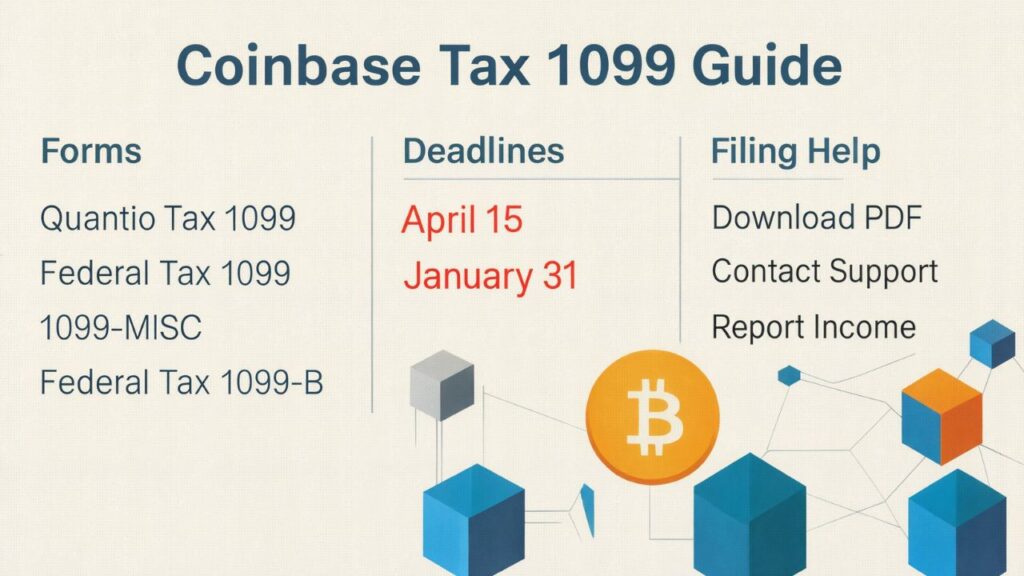
The big change is Form 1099-DA. The IRS says broker reporting for digital asset transactions is required on Form 1099-DA beginning with transactions on or after January 1, 2025. Coinbase says it will provide tax year 2025 Form 1099-DA to U.S. customers no later than March 17, 2026.
This article explains the forms in simple language. It is educational only, not personal tax advice. Crypto tax treatment can depend on your full transaction history, location, income type, transfers, wallets, and filing situation, so a qualified tax professional can help when the numbers are large or messy.
Table of Contents
- What Does Coinbase Tax 1099 Mean?
- Which Tax Forms Does Coinbase Provide?
- Coinbase 1099-DA: What Changed for Digital Assets
- Coinbase 1099-MISC for Rewards and Income
- Coinbase 1099-B and Other Tax Documents
- How to Find Coinbase Tax Documents
- How Coinbase Tax Forms Connect to Your Tax Return
- Cost Basis, Gains, Losses, and Missing Data
- Common Coinbase Tax 1099 Mistakes to Avoid
- Recordkeeping Tips for Coinbase Users
- Personal and Financial Safety Insight
- FAQs
- Conclusion
What Does Coinbase Tax 1099 Mean?
The phrase coinbase tax 1099 usually refers to tax forms Coinbase may issue to U.S. customers and the IRS. These forms report certain types of account activity, such as gross proceeds from crypto sales or exchanges, rewards income, futures or securities sales, dividends, or other reportable activity.
A 1099 form is not the same as a completed tax return. It is an information report. It gives you and the IRS details that may need to be matched with your own tax filing.
That part matters. A form may show proceeds, but you may still need to calculate gains, losses, cost basis, holding period, transfers from other wallets, and other income items.
In simple words, coinbase tax 1099 forms help report taxable activity, but they do not always tell the whole story by themselves.
Which Tax Forms Does Coinbase Provide?
Coinbase lists several possible tax forms for U.S. customers. The form you receive depends on your activity.
| Coinbase Tax Form | Who May Receive It | What It Generally Reports |
|---|---|---|
| Form 1099-DA | U.S. customers with gross proceeds from sales or exchanges of crypto assets | Digital asset sale or exchange proceeds |
| Form 1099-MISC | U.S. customers who earned more than $600 in crypto income, including staking rewards and incentives | Miscellaneous income |
| Form 1099-B | U.S. customers who sold futures, securities, or other financial instruments | Broker-reported securities or futures activity |
| Form 1099-DIV | U.S. customers who earned more than $10 in dividends or capital gain distributions from investments | Dividends or distributions |
| Form 8949 report | Used to help report capital gains and losses | Transaction-level gain/loss information |
| Coinbase’s tax information page lists these forms and explains the eligibility categories for each one. | ||
| Not every Coinbase user gets every form. For example, someone who only bought crypto and held it may have a different tax document situation than someone who sold, swapped, earned staking rewards, or traded other financial products. |
Coinbase 1099-DA: What Changed for Digital Assets
Form 1099-DA is the biggest recent change in Coinbase crypto tax reporting. The IRS says Form 1099-DA is used to report digital asset proceeds from broker transactions.
Coinbase says that starting with the 2025 tax year, it is required to issue Form 1099-DA to U.S. customers, and that the form is intended to standardize gross proceeds and cost basis reporting from crypto sales and exchanges.
What 1099-DA May Show
Form 1099-DA may include information such as:
- Broker information
- Customer information
- Digital asset sold or exchanged
- Gross proceeds
- Transaction details
- Possible cost basis information, depending on the year and reporting rules
- Whether certain information was reported to the IRS
Coinbase has also explained that for tax year 2025, Form 1099-DA cost basis information may be reported to customers, but not reported to the IRS for that year.
Why Gross Proceeds Are Not the Same as Profit
This is one of the most important points. Gross proceeds usually mean the amount received from a sale or exchange before subtracting what you paid for the asset.
Example:
| Item | Amount |
|---|---|
| You bought crypto for | $4,000 |
| You later sold it for | $6,000 |
| Gross proceeds | $6,000 |
| Cost basis | $4,000 |
| Possible gain before fees/adjustments | $2,000 |
| If you only look at proceeds, the number can seem much larger than the actual gain. That is why cost basis records matter so much. |
Coinbase 1099-MISC for Rewards and Income
Coinbase issues Form 1099-MISC to report certain miscellaneous income rewards to U.S. customers who meet the criteria. Coinbase says Form 1099-MISC is for U.S. customers who earned more than $600 in crypto income, including staking rewards and incentives.
This can include income-style activity, not regular buy-and-hold activity.
Examples of Crypto Income
Depending on the account activity, crypto income may include:
- Staking rewards
- Learning rewards
- Referral bonuses
- Promotional incentives
- Other reward-type payments
Income reported on a 1099-MISC is different from capital gains on sold crypto. Rewards may be treated as income when received, while later selling the rewarded crypto may also create a gain or loss based on value changes.
Simple Example
Suppose a user earns $800 in staking rewards during the year. Coinbase may issue Form 1099-MISC if the user meets the reporting criteria. If the user later sells those rewards, there may also be a separate sale or exchange calculation.
That is why coinbase tax 1099 planning should include both income and capital gain records.
Coinbase 1099-B and Other Tax Documents
Coinbase says Form 1099-B applies to U.S. customers who sold futures, securities, or other financial instruments. Coinbase also says it will provide Form 1099-B for tax year 2025 in early 2026.
This is separate from regular crypto sales reported on Form 1099-DA.
Coinbase also describes a consolidated Form 1099 as a single document that can combine multiple 1099 forms into one statement. Coinbase says users can view or download IRS forms in the Documents section of the Coinbase Tax Center.
Why You May See More Than One Form
A user may receive more than one tax document if they had different types of activity. For example:
| Activity | Possible Form |
|---|---|
| Sold or exchanged crypto | 1099-DA |
| Earned staking rewards above threshold | 1099-MISC |
| Sold eligible futures or financial instruments | 1099-B |
| Earned dividends or capital gain distributions from investments | 1099-DIV |
| One Coinbase account can create different tax reporting needs if the user uses multiple Coinbase products. |
How to Find Coinbase Tax Documents
Coinbase says IRS forms can be found in the Documents section of the Coinbase Tax Center.
A safe general process is:
- Sign in to Coinbase from the official website or app.
- Go to the tax area or Coinbase Tax Center.
- Open the documents section.
- Download available tax forms.
- Save copies for your records.
- Compare forms with your own transaction history.
- Share documents with your tax preparer if needed.
Avoid downloading tax documents through random email links, social media messages, or fake support pages. Tax forms contain sensitive information, and crypto users are frequent scam targets.
How Coinbase Tax Forms Connect to Your Tax Return
Coinbase forms are only part of the tax filing process. The IRS reminds taxpayers that anyone who sold crypto, received it as payment, or had other digital asset transactions needs to accurately report digital asset-related income on the return.
Sales and Exchanges
Crypto sales and exchanges are usually reported as capital transactions. The IRS says Form 8949 is used to reconcile amounts reported to taxpayers and the IRS on certain information forms with amounts reported on the return; subtotals then carry to Schedule D.
For crypto, this generally means you may need:
- Sale date
- Purchase date
- Proceeds
- Cost basis
- Gain or loss
- Short-term or long-term classification
- Fees or adjustments, where applicable
Rewards and Income
Crypto rewards or other income-style activity may need to be reported as income, depending on the activity. A coinbase tax 1099-MISC can help identify income amounts, but the user still needs to include the information correctly on the tax return.
Transfers
Moving crypto from one wallet you own to another wallet you own is different from selling or exchanging crypto. However, transfers can affect cost basis tracking because the receiving platform may not know the original purchase price.
Cost Basis, Gains, Losses, and Missing Data
Cost basis is usually what you paid for an asset, plus certain costs or adjustments. Without cost basis, a sale form can look worse than reality because it may show proceeds without showing what you originally paid.
This is especially important with coinbase tax 1099 reporting because crypto users often move assets across exchanges, wallets, DeFi platforms, and cold storage. Coinbase may not always know the full history of assets transferred in from outside wallets.
Example of Missing Cost Basis
| Scenario | What Happens |
|---|---|
| You bought ETH on another exchange | Coinbase may not know the original purchase price |
| You transferred ETH to Coinbase | Coinbase sees the transfer in, but not always the full basis |
| You sold ETH on Coinbase | A tax form may show proceeds, but basis may need your records |
| If cost basis is wrong or missing, your reported gain or loss may be wrong. That can lead to overreporting, underreporting, or extra questions later. |
Records That Help
Keep:
- Purchase confirmations
- Sale records
- Exchange records
- Wallet transfer history
- Cost basis reports
- CSV transaction exports
- Staking reward records
- Fee records
- Previous tax returns
A clean record system can save hours when tax season arrives.
Common Coinbase Tax 1099 Mistakes to Avoid
Thinking a 1099 Is the Full Tax Return
A 1099 is not the whole filing. It is one information document. You still need to report the activity properly.
Ignoring Small Transactions
Small sales, swaps, rewards, or payments can still matter. The IRS digital asset question applies broadly to digital asset activity on the tax return.
Confusing Proceeds With Profit
Gross proceeds are not the same as taxable gain. Cost basis and fees can change the actual result.
Forgetting Other Exchanges and Wallets
Coinbase only has Coinbase-related information. If you used other exchanges, wallets, or platforms, you may need to include those records too.
Not Checking Personal Details
Make sure your name, taxpayer identification information, and account details are correct. Mismatched tax details can create notices or backup withholding issues.
Waiting Until the Deadline
Crypto taxes can take time. Waiting until the last week can make missing basis, CSV exports, or wallet transfers much harder to fix.
Using Random Tax Advice Online
Crypto tax rules are complex. Use official sources, reputable tax software, or a qualified tax professional when needed.
Recordkeeping Tips for Coinbase Users
Good records are the best defense against confusion.
Download Early
Download tax documents as soon as they are available. Coinbase says tax year 2025 Form 1099-DA will be provided no later than March 17, 2026.
Export Transactions
Keep a copy of your transaction history, not only the final tax form.
Track Transfers
Transfers between wallets may not be taxable by themselves, but they help explain where coins came from and what basis belongs to them.
Keep Notes for Unusual Activity
If you had a failed transaction, duplicate transfer, airdrop, chain migration, or platform issue, write down what happened while you still remember.
Reconcile Before Filing
Compare:
- Coinbase forms
- Coinbase transaction history
- Other exchange reports
- Wallet records
- Tax software output
- Prior-year carryover data
This step can catch missing basis, duplicate imports, or wrong classifications.
Personal and Financial Safety Insight
This topic is not about a public person, so personal background, career journey, achievements, and net worth do not apply in the usual profile sense. But the financial lesson is very real.
A coinbase tax 1099 can affect how your crypto activity appears to the IRS. That does not mean you should panic. It means you should slow down, gather records, and avoid guessing.
The safest habit is to treat crypto taxes like bookkeeping, not like a last-minute form. Every buy, sale, swap, reward, and transfer tells part of the story. When the story is complete, filing becomes less stressful.
For simple activity, Coinbase forms and tax software may be enough. For complex activity, large gains, transfers across many wallets, staking, business payments, DeFi, NFTs, or missing basis, getting professional help can be a wise choice.
FAQs
What is Coinbase tax 1099?
Coinbase tax 1099 refers to tax forms Coinbase may issue to U.S. customers, such as Form 1099-DA, 1099-MISC, 1099-B, 1099-DIV, or consolidated 1099 documents, depending on account activity.
Does Coinbase send Form 1099-DA?
Yes. Coinbase says that starting with tax year 2025, it is required to issue IRS Form 1099-DA to U.S. customers.
When will Coinbase provide 2025 Form 1099-DA?
Coinbase says it will provide tax year 2025 Form 1099-DA no later than March 17, 2026, and users will receive an email when it is ready for download.
Does Coinbase issue Form 1099-MISC?
Yes. Coinbase says it issues Form 1099-MISC to report miscellaneous income rewards to U.S. customers who meet certain criteria
What is the Coinbase 1099-MISC threshold?
Coinbase says Form 1099-MISC applies to U.S. customers who earned more than $600 in crypto income, including staking rewards and incentives.
Does Coinbase issue Form 1099-K?
Coinbase states that it does not issue IRS Form 1099-K.
Where do I download Coinbase tax forms?
Coinbase says users can view or download IRS forms in the Documents section of the Coinbase Tax Center.
Is a Coinbase 1099 the same as my tax return?
No. A Coinbase 1099 is an information form. You may still need to calculate gains, losses, income, cost basis, and report the correct totals on your tax return.
What if my Coinbase tax 1099 has missing cost basis?
You may need to use your own records, transfer history, other exchange reports, or tax software to calculate basis. A tax professional can help when basis is unclear.
Do I need Form 8949 for Coinbase crypto sales?
Many crypto sales and exchanges are reported using Form 8949 and Schedule D. The IRS says Form 8949 is used to reconcile reported sale amounts and carry subtotals to Schedule D.
Conclusion
Coinbase tax 1099 reporting is becoming more standardized, especially with the arrival of Form 1099-DA for digital asset proceeds. That can make tax season easier in some ways, but it also makes good records more important.
Download your Coinbase documents, review the forms carefully, check cost basis, include other wallets or exchanges, and do not confuse gross proceeds with profit. When the activity is simple, the process may be manageable. When the activity is complex, careful reconciliation or professional tax help can save you from costly mistakes.