Picture this: your phone’s operating system gets an update, and suddenly half of your apps crash because they were built for the old version. Annoying, right? Blockchains face a similar challenge, but they’ve developed a clever way to evolve without leaving anyone behind. That’s where the soft fork comes in. If you’ve ever found yourself staring at a crypto headline and wondering what is a soft fork, you’re in the right place. This isn’t some abstract developer jargon – it’s a practical, time‑tested mechanism that has quietly safeguarded hundreds of billions of dollars in digital assets.
In this guide, I’ll walk you through exactly how a soft fork works, why it matters to anyone who holds cryptocurrency, and how it stacks up against its louder sibling, the hard fork. We’ll look at real‑world battles, famous upgrades, and the delicate governance dance that keeps networks like Bitcoin running smoothly. By the time you finish reading, you’ll not only know what is a soft fork – you’ll understand why it’s the unsung hero of blockchain evolution.
So, What Exactly Is a Soft Fork?
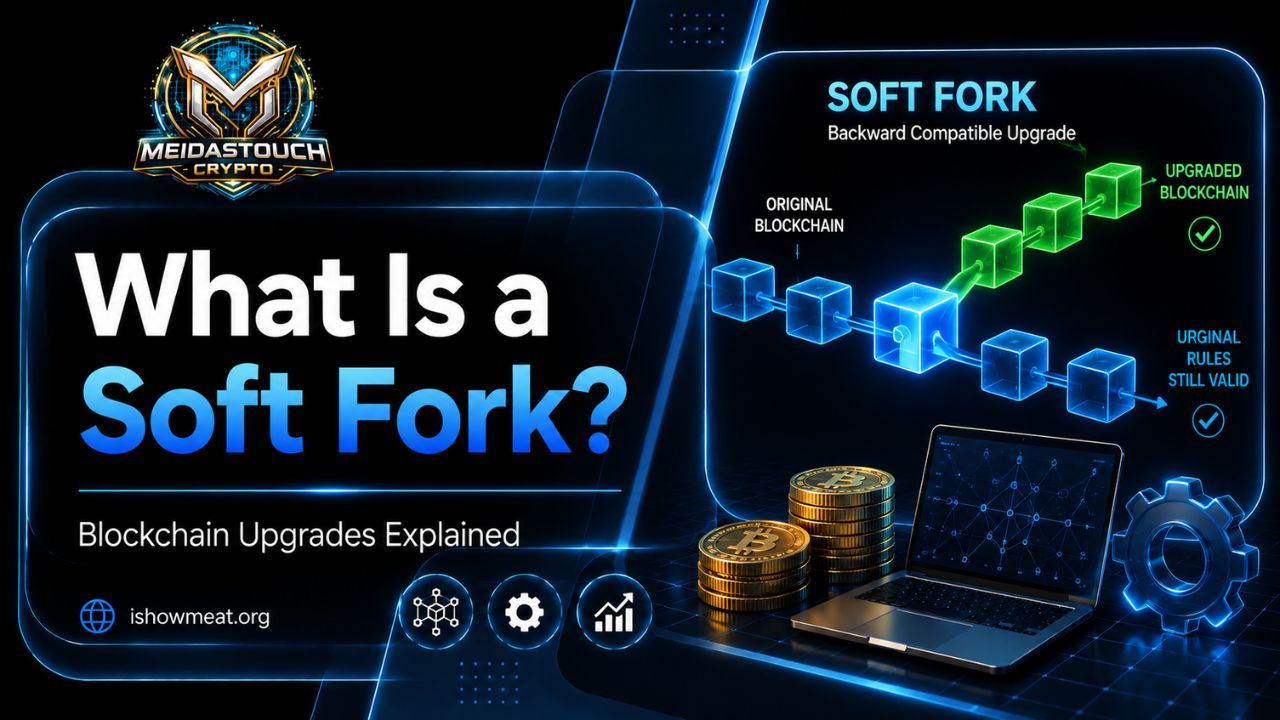
Let’s cut through the noise. A soft fork is a change to a blockchain’s protocol rules that is backward‑compatible. That’s the one‑sentence answer. But to really nail down what is a soft fork, you need to picture a blockchain as a giant shared rulebook. Every node (the computers that validate transactions) follows that book to the letter. When a soft fork happens, the rules tighten: new blocks must follow stricter conditions, but old nodes can still accept them because they don’t break the original, broader rules.
Think of it like updating a restaurant’s dress code. The old rule said, “No swimsuits.” A soft fork would add, “No flip‑flops either.” Someone wearing a shirt and jeans still gets in fine. But if you show up in flip‑flops, the bouncer (updated nodes) turns you away. The older host at the door (non‑updated node) might let you in because he only checks for swimsuits, but he’ll happily accept the shirt‑and‑jeans crowd the new bouncer lets through. The system doesn’t split; it just gets a bit pickier.
That’s the magic of backward compatibility. The old node doesn’t get confused. It just sees a valid block, shrugs, and adds it to the chain. Meanwhile, upgraded nodes enforce the extra rule. As long as the majority of miners or stakers are on the same page, the network keeps humming along with a single, unified transaction history.

Tightening the Rules Without Breaking the Chain
A soft fork works by making previously valid blocks or transactions invalid under the new protocol. Because the change only restricts what’s allowed, rather than expanding it, the blockchain can avoid the dreaded chain split – the one‑network‑becomes‑two scenario that scares so many people. In a soft fork, the original chain continues to be the longest valid chain as far as non‑upgraded nodes are concerned. They simply won’t produce blocks that violate the new rules, because the majority of mining power (or stake) rejects them.
To put it technically, a soft fork reduces the set of acceptable block templates. That’s why it’s called a “soft” fork: the network doesn’t fracture, and old client software can still follow the chain without an immediate upgrade. It’s a gentle tightening, not a tear.
Why “Fork” Is a Slightly Confusing Word
In blockchain, a fork just means a divergence in the protocol – or sometimes a temporary split in the chain before resolution. With a soft fork, the divergence is in the rules, not in the permanent ledger. Non‑upgraded nodes stay on the same chain; they just don’t realize they’re missing some enforcement details. As soon as a majority of hash power or stake enforces the new rules, any incompatible blocks get orphaned quickly. The network converges on a single reality. That’s a stark contrast to a hard fork, where old nodes reject new blocks entirely and two incompatible blockchains emerge side by side.
How a Soft Fork Actually Works Under the Hood
Now that you’ve got the big picture, let’s pop the hood and see the engine. A blockchain is a chain of blocks, each containing a list of transactions and a reference to the previous block. For a new block to be accepted, it must pass a series of validation checks – the consensus rules. These rules cover things like signature validity, block reward limits, transaction format, and, in Bitcoin’s case, the size of certain data fields.
A soft fork modifies one or more of these rules in a restrictive way. For instance, it might say, “From now on, a block must leave the first byte of a particular field empty, or it’s invalid.” Old nodes don’t check that byte at all, so they see the block as perfectly fine. Upgraded nodes see the empty byte and nod approvingly. If a miner tries to put data into that forbidden byte, upgraded miners reject the block, and because most miners are upgraded, that block dies in the mempool.
This is why miner signalling is so crucial. Soft forks often use a mechanism called Miner Activated Soft Fork (MASF) where miners coordinate by flipping a bit in the block header to signal readiness. Once a supermajority (say 95%) of blocks signal support within a window, the new rules lock in. From that point forward, all nodes that enforce the new rules will reject non‑compliant blocks. Nodes that haven’t updated won’t even notice the change – they just follow the longest valid chain, which happens to be fully compliant.
The Role of Block Version Bits and BIP 9
Bitcoin formalized this process with BIP 9 (Bitcoin Improvement Proposal 9). It introduced version bits, allowing multiple soft forks to be signalled simultaneously. Each soft fork gets assigned a bit. Miners set that bit to 1 in their blocks to indicate support. When a threshold is reached over a 2,016‑block difficulty period, the fork activates. This elegant system has been used for upgrades like SegWit (Segregated Witness) and Taproot.
Take SegWit as a prime example. SegWit was a soft fork that restructured how transaction signatures were stored, effectively fixing transaction malleability and increasing block capacity. By moving witness data to a separate structure, the block size limit appeared to grow without actually changing the 1 MB base limit. Old nodes saw the witness‑free block and validated it, while new nodes saw the full data. The result? A backward‑compatible upgrade that boosted throughput and paved the way for the Lightning Network.
User Activated Soft Fork (UASF) – When the Community Pushes Back
Sometimes, miners drag their feet. That’s where the User Activated Soft Fork (UASF) comes in. Instead of waiting for miner signalling, economic nodes (exchanges, wallets, full node operators) collectively enforce the new rules on a flag day. If a majority of the economic activity refuses to accept non‑signalling blocks, miners have a financial incentive to fall in line, because otherwise their blocks get rejected by the market.
The most famous UASF was BIP 148, which forced SegWit activation in 2017. A portion of the Bitcoin community set a date – August 1 – and declared that any block not signalling for SegWit would be rejected. This brinksmanship worked. Miners, fearing a chain split and lost revenue, eventually locked in SegWit via the MASF before the deadline. It was a powerful demonstration of decentralized governance and a defining moment for anyone trying to grasp what is a soft fork in a real‑world political context.
Soft Fork vs Hard Fork: The Showdown
No explanation of soft forks is complete without comparing them to hard forks. The two are frequently confused, but they serve very different purposes and carry drastically different risks. I’ll break it down in a way that makes it stick.
| Aspect | Soft Fork | Hard Fork |
|---|---|---|
| Backward Compatibility | Yes – old nodes follow the same chain. | No – old nodes reject new blocks, causing a split. |
| Chain Split | No permanent split; one chain wins. | Permanent split unless all nodes upgrade. |
| Node Upgrades | Voluntary for non‑mining nodes; miners must upgrade. | All nodes must upgrade to follow the new chain. |
| Rule Change Direction | Restrictive (tighter rules). | Expansive (looser or different rules). |
| Risk Level | Lower – risk of temporary orphans if poorly managed. | Higher – risk of a permanent community divide. |
| Classic Examples | Bitcoin SegWit, Taproot, P2SH. | Bitcoin Cash (from Bitcoin), Ethereum’s DAO fork. |
| Network Effect | Preserves unified ledger. | Splits community and hash power. |
| Activation | MASF or UASF, with supermajority threshold. | Often requires a flag day and universal support. |
When someone asks you about a blockchain fork, the first question you should ask is, “Soft or hard?” Because the consequences are worlds apart. A soft fork is like repainting the lines in a parking lot – you can still park your car in the same spot, but you better stay inside the new lines. A hard fork is like digging an entirely new parking lot across the street and hoping everyone moves their car.
Why Soft Forks Are the Preferred Upgrade Path
For major public blockchains like Bitcoin and Litecoin, soft forks are the gold standard. They let the network evolve without forcing every single user to download new software immediately. Exchanges, wallet providers, and casual holders can continue operating as normal, even as the protocol gets meaningful upgrades. This is critical for networks that value security and continuity above all else.
Hard forks, by contrast, often arise from irreconcilable ideological differences. Bitcoin Cash, for example, hard forked from Bitcoin in 2017 over block size debates. It created a separate coin, a separate community, and years of confusion. A soft fork sidesteps that chaos. It’s a more conservative, surgical tool.
Real‑World Soft Fork Examples That Shaped Crypto
To make this tangible, let’s walk through some of the most important soft forks in cryptocurrency history. These aren’t just trivia – they’re case studies in how protocol evolution actually happens.
Bitcoin’s P2SH (Pay to Script Hash) – BIP 16
Long before SegWit, Bitcoin introduced a soft fork called P2SH in 2012. It let senders lock funds to the hash of a script instead of a raw public key, dramatically simplifying multisig wallets and enabling more complex spending conditions. Old nodes saw a strange looking output but still validated the transaction because it followed the general output format. New nodes recognized the hash and enforced the script requirement when spending. P2SH was a soft fork that made Bitcoin far more flexible without anyone needing to panic‑upgrade. It set the template for countless upgrades to come.
Segregated Witness (SegWit) – BIP 141
I already touched on SegWit, but it deserves a deeper look. Activated in 2017, SegWit solved transaction malleability – a bug that let attackers tweak transaction IDs before confirmation – and increased the effective block size to around 2‑3 MB by separating signature data. The activation journey was a political thriller. Originally proposed as a MASF using BIP 9, it stalled at around 30% miner signalling for months. That’s when the UASF movement gathered steam, pushing the soft fork forward through economic pressure. Ultimately, SegWit locked in, and today over 90% of Bitcoin transactions use SegWit outputs. It’s the perfect illustration of what is a soft fork in practice: a backward‑compatible tightening that brought massive functionality gains without splitting the network.
Taproot – BIP 341
Fast forward to November 2021. Bitcoin activated Taproot, another soft fork. Taproot introduced Schnorr signatures and a new scripting language called Tapscript, making multi‑signature transactions look like ordinary payments and improving privacy and efficiency. It was activated via the “Speedy Trial” method – a variant of MASF with a shorter time window. Taproot enjoyed broad support from miners and the community, locking in quickly. Because it was a soft fork, older clients that didn’t understand Taproot still saw valid transactions. The upgrade was seamless for most users. It’s a testament to how soft forks can roll out sophisticated cryptography without breaking the network.
Litecoin’s Adoption of SegWit
Litecoin, often described as the silver to Bitcoin’s gold, activated SegWit as a soft fork in May 2017, months before Bitcoin did. Litecoin’s smooth activation served as a real‑world test bed and gave the Bitcoin community confidence that the process worked. It also highlighted that the soft fork mechanism is chain‑agnostic. Any blockchain with enough hash power coordination can upgrade this way.
These examples show that when you hear “protocol upgrade,” the safe bet is that it’s a soft fork. The alternative – a hard fork – tends to make headlines for all the wrong reasons.
The Pros and Cons of a Soft Fork
No technology is flawless. A soft fork brings clear advantages but also carries some subtle drawbacks. Let’s lay them out honestly.
Advantages
- No Network Split: The biggest selling point. A well‑executed soft fork keeps everyone on the same ledger. You don’t wake up with two different coins in your wallet.
- Backward Compatibility: Non‑upgraded nodes can still validate and propagate transactions. Exchanges and light wallets don’t have to scramble to upgrade on day one.
- Lower Coordination Overhead: You only need a supermajority of miners (or stake) to enforce the new rules. Regular users can upgrade at their leisure.
- Proven Track Record: As we saw with SegWit and Taproot, soft forks have successfully delivered major improvements to the world’s largest blockchain.
- Market Stability: No new coin creation means no speculative confusion, preserving network effects and token value.
Disadvantages
- Limited Scope: Because you can only tighten rules, you can’t use a soft fork to increase the maximum block size beyond what old nodes expect, or to change the coin’s monetary policy in a way that loosens constraints. That’s why block size wars couldn’t be solved with a simple soft fork.
- Old Nodes Have Weaker Security: Non‑upgraded nodes don’t enforce the new rules. They rely on the economic majority to do so. If an attacker could coax old nodes into a false chain, it might be a problem – though in practice, SPV wallets and light clients typically follow the chain with the most work, which stays honest.
- Messy Activation Politics: As the UASF saga showed, soft fork activation can turn into a bitter public fight. Markets hate uncertainty.
- “Zombie” Nodes Risk: Some nodes may never upgrade, and over many soft forks, the gap between what the network actually enforces and what old nodes think is valid can widen. This is more of a philosophical concern than a practical one.
In the grand scheme, the advantages of a soft fork vastly outweigh the downsides for most upgrade scenarios. That’s why core developers consistently choose this path.
Activation Mechanics: MASF, UASF, and Speedy Trial
We’ve name‑dropped these terms, so let’s solidify them. Understanding activation deepens your grasp of what is a soft fork because it reveals the delicate coordination game at the heart of decentralized systems.
MASF – Miner Activated Soft Fork
The standard route. A proposal is written as a BIP (Bitcoin Improvement Proposal) that defines a threshold – commonly 95% of blocks within a 2,016‑block window. Miners include a signal in the block header. Once the threshold is met, the soft fork locks in and activates after a grace period. This ensures the new rules are enforced by virtually all of the mining power, so orphan risks are minimal. Taproot used a modified version called “Speedy Trial” with a 3‑month window to avoid endless signalling limbo.
UASF – User Activated Soft Fork
When miners don’t signal, the economic nodes can force the issue. A UASF node modifies its software to reject blocks that lack the signal after a predetermined date. If enough of the economy (exchanges, payment processors, large holders) runs UASF nodes, miners will fall in line to avoid producing blocks that get ignored by the market. BIP 148 is the canonical example. It was a risky move, but it preserved the principle that users ultimately control the network.
The Hybrid Reality
Most soft forks today combine the two: miners signal to lock in the upgrade, but the threat of a UASF keeps them honest. This balance of power is a beautiful innovation in human coordination – and it’s unique to blockchain technology.
Common Misconceptions About Soft Forks
Soft forks are misunderstood even among experienced crypto users. Let’s clear up a few myths.
Myth 1: A soft fork never causes a chain split. In theory, a soft fork shouldn’t split the chain permanently. But if miners abandon the fork during activation, or if a UASF triggers without majority hash power, temporary forks can occur. However, the longest chain rule eventually resolves it, and the fork resolves without a new coin.
Myth 2: Soft forks are completely safe for old nodes. Old nodes rely on the miners to enforce the new rules. If a malicious miner builds on a non‑compliant chain and gets old nodes to follow it, those nodes could be tricked – but in proof‑of‑work, the chain with the most accumulated difficulty is almost certainly the honest one because of economic incentives.
Myth 3: Soft forks can do anything. Nope. They can’t increase the maximum block size beyond what legacy clients accept, they can’t change the coin issuance schedule to increase supply, and they can’t alter the proof‑of‑work algorithm in a way old nodes would reject. For those changes, a hard fork is necessary.
Myth 4: Soft forks are less political. The SegWit battles prove otherwise. Protocol changes always involve human interests, and soft fork activation can become a proxy war over network control.
Grasping these nuances is what separates a casual observer from someone who truly understands what is a soft fork.
The Future of Soft Forks in Blockchain Innovation
Soft forks aren’t going anywhere. As blockchains get more complex and the stakes get higher, the ability to upgrade gracefully becomes even more critical. We’re seeing research into even smoother activation methods, like BIP 8 with mandatory signalling, and ideas to combine soft forks with layer‑2 scaling solutions.
The Ethereum network, which moved to proof‑of‑stake, also uses a form of soft‑fork‑like updates through its epoch‑based consensus, though its upgrade process involves coordination among client teams. Other chains like Cardano and Polkadot have formalized governance that mimics the soft fork’s tightening logic without the raw miner‑user standoff.
What’s clear is that the concept of a backward‑compatible protocol upgrade is one of the most durable innovations to come out of the Bitcoin experiment. It’s a quiet engineering marvel that lets multi‑billion‑dollar networks evolve without centralized control. So, the next time you hear about a network upgrade and wonder what is a soft fork, you’ll know it’s far more than a technical footnote – it’s the glue that holds decentralized communities together.
Frequently Asked Questions About Soft Forks
What is a soft fork in cryptocurrency?
A soft fork is a blockchain protocol change that tightens the consensus rules, making previously valid blocks or transactions invalid. Because it is backward‑compatible, old nodes can still follow the chain without upgrading, and the network avoids a permanent split.
How is a soft fork different from a hard fork?
A soft fork remains backward‑compatible; old nodes accept new blocks. A hard fork creates a permanent split, where old nodes reject the new chain entirely, resulting in two separate networks and usually a new coin.
Is Bitcoin’s SegWit a soft fork?
Yes, Segregated Witness (SegWit) was a soft fork activated on Bitcoin in 2017. It restructured witness data to fix malleability and increase capacity without breaking compatibility with older node software.
Can a soft fork lead to a chain split?
Temporary forks can occur if not enough miners enforce the new rules, but the network eventually converges on the longest valid chain. A permanent split that spawns a new cryptocurrency is almost impossible with a properly executed soft fork.
What is a user activated soft fork (UASF)?
A UASF is when economic nodes (exchanges, wallets, users) enforce a soft fork without miner signalling, setting a flag day after which they reject non‑signalling blocks. It’s a mechanism for the community to push upgrades through against miner reluctance.
Does a soft fork require all nodes to update?
No. Only miners (or stakers) and nodes that want to enforce the new rules must update. Old nodes continue to function, though they won’t enjoy the full security benefits of the upgrade.
What are some famous soft forks besides SegWit?
Bitcoin’s P2SH (2012) and Taproot (2021) are two notable ones. Litecoin also activated SegWit via a soft fork, and many altcoins have used the mechanism for routine upgrades.
6. FAQ Section (as separate output list)
- What is a soft fork? A backward‑compatible blockchain protocol upgrade that tightens rules without forcing all nodes to update.
- How does a soft fork differ from a hard fork? Soft forks keep the chain unified; hard forks create a permanent split and a new coin.
- Is SegWit a soft fork? Yes, Bitcoin’s SegWit upgrade was implemented as a soft fork.
- Can a soft fork cause a chain split? Temporarily, yes, but not permanently – the network converges on one chain.
- What does UASF mean? User Activated Soft Fork, where economic nodes force a soft fork without waiting for miners.
- Do I need to upgrade my wallet for a soft fork? Not urgently; non‑mining nodes can continue operating, though upgrading is recommended for full rule enforcement.
- Why are soft forks preferred over hard forks? They avoid community splits, preserve the coin’s unity, and require less coordination.